Public green space is judged every day by thousands of people who did not schedule their visit around the maintenance roster. A lawn that looked immaculate after a Monday cut can be long and patchy by Sunday, and the windows when crews are actually allowed to run a noisy petrol mower — early morning, weekdays, outside peak visiting hours — keep shrinking as cities and property managers prioritise quiet and public safety.
This guide explains why traditional crew mowing struggles on parks and managed landscapes, how a fully autonomous electric mower changes the routine, and what grounds and facilities managers should check before specifying one. It covers the four places the question comes up most often: large public parks, municipal road green belts, industrial parks and corporate or institutional campuses.
Why park turf is harder to maintain than it looks
The grass itself is rarely the problem. The conditions around it are.
Large, dispersed acreage on a fixed budget
A single parks department or property team may be responsible for a flagship park, several smaller pocket parks, kilometres of road verges and the grounds around public buildings. Crews move between sites with trailer and ride-on mower, and a surprising share of the working day is spent relocating, unloading and hand-trimming around fixed furniture. As growing cities add green space faster than they add maintenance headcount, the area each worker has to cover keeps rising.
Frequent cutting, with a high standard and a low tolerance for noise
Ornamental lawn needs cutting little and often to stay dense and even; let it grow long and scalp it back and the finish is poor for weeks. But parks and campuses are occupied from early morning exercise through evening events. Conventional mowers are loud enough to draw complaints from nearby residents, offices, hospital wards and hotel guests, which pushes mowing into a narrow early window that is never quite long enough to cover everything on time.
A working environment full of people and fixed obstacles
Benches, picnic tables, lamp posts, bollards, tree pits, sign boards, playground edges, path curves and kerbs are scattered across the grass. People walk across it, children run, dogs roam off leads and bicycles cut through. Any machine running there has to be quiet around the public, and it has to reliably avoid them.
What the R1 actually is
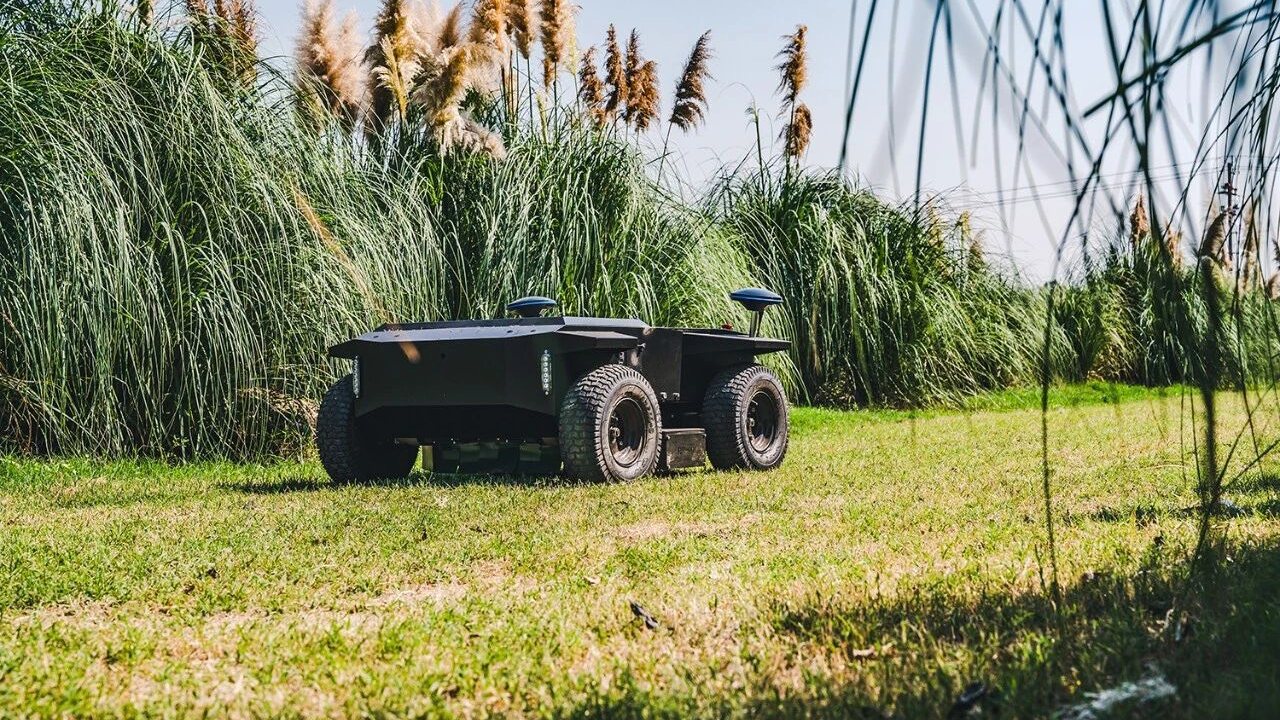
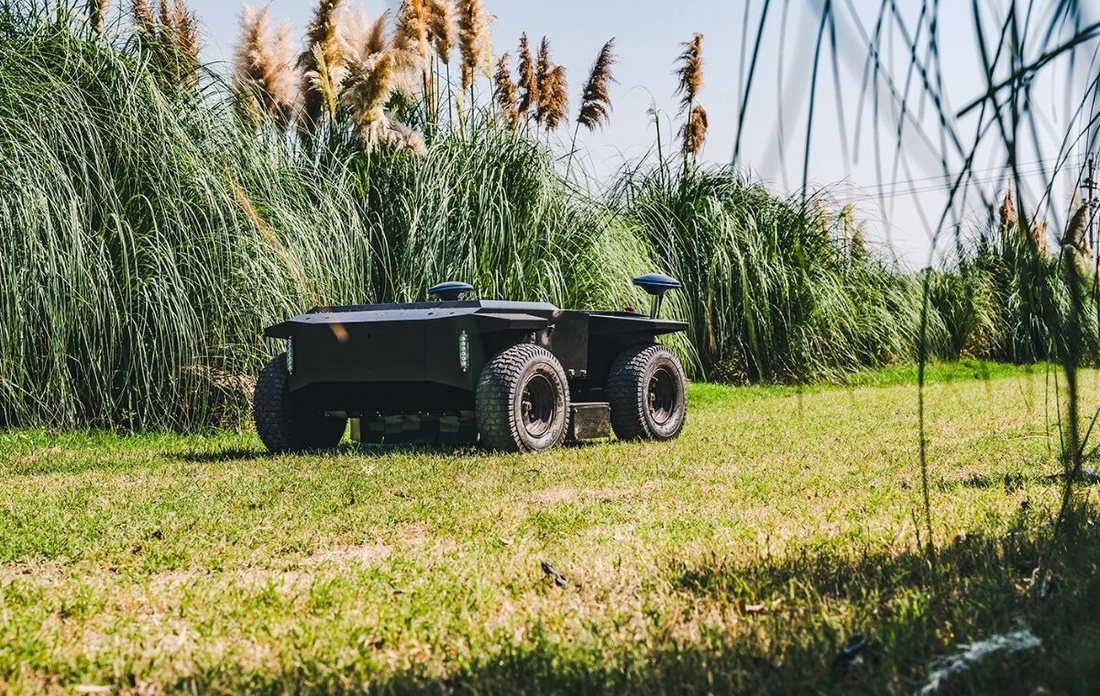
The R1 is a commercial-grade, fully autonomous wheeled mower. It is not a consumer robot scaled up, and it is not radio-controlled by an operator: after the area is mapped once, it plans the route, mows, detects and avoids obstacles, resumes interrupted work and returns to its charging station by itself.
The numbers grounds managers work with:
- 790 mm cutting width with dual blades, cutting height adjustable from 20 to 100 mm
- ~2,000 m² per hour of work rate, with one removable battery pack covering roughly 2 hours / 4,000 m²
- Fully electric — 48V lithium iron phosphate (LiFePO4) battery, low operating noise, no exhaust and no fuel stored on site
- Four-wheel drive with differential steering and zero-radius turning
- RTK-GNSS (±2 cm) plus LiDAR for route navigation and obstacle detection, with virtual boundaries and exclusion zones drawn in the app
Why it fits public and commercial green space
Mow during visiting hours, quietly
This is the biggest operational change. Because the R1 is electric and runs at a fraction of the noise of a petrol ride-on, mowing no longer has to be squeezed into an unpopular early-morning slot. The machine can work through the day while the park is open, and visitors see the grounds being quietly maintained rather than being chased off a lawn by noise and fumes. The same quality of cut is delivered on a Wednesday afternoon as on a quiet Monday.
No exhaust over a playground, no engine noise beside a ward or an office block — in places that sell themselves on clean air and quiet, the maintenance equipment finally matches the promise.
Turn in place around benches and path furniture
Differential steering lets the machine pivot in place instead of needing a wide turning circle. Around benches, lamp posts, tree pits and the curves of a path edge, that means far fewer “mower-shaped” missed patches and much less follow-up work with a line trimmer. Four-wheel drive keeps it moving across the gentle undulations and slightly soft ground common in landscaped parks.
One machine, the right height for every zone
Cutting height is adjustable between 20 and 100 mm, so the same machine can be set lower for a closely manicured ornamental lawn or event field and higher for a naturalistic meadow edge, a shaded verge or drought-stressed summer grass. Zones are saved in the app, so the height and schedule for each area are applied consistently rather than left to whichever crew member happens to be on shift.
Systematic coverage, not a driver's best guess
RTK-GNSS at roughly ±2 cm gives the machine its planned path, so it mows the whole zone in an efficient pattern with even overlap instead of wandering and double-cutting. LiDAR handles what is actually on the path — a person stepping onto the lawn, a dog, a child's toy, a temporary sign — detecting and avoiding it in real time. Because the same stored route repeats every cycle, finish quality is consistent across weeks and across sites, rather than varying with the operator.
Virtual boundaries, with no wire buried in public ground
The working area and exclusion zones — playgrounds, ponds, flowerbeds, paths, plazas, utility covers, event spaces — are drawn in the mobile app. There is no perimeter cable to trench into a park, and no cable to cut when a path is repaired or an event is staged. When a temporary marquee or market is set up, the zone is redrawn for that week and restored afterwards. If a run is interrupted or a pack runs low, the mission resumes from where it stopped and the machine returns to charge automatically.

Swappable LiFePO4 packs for a full day of zones
The removable 48V lithium iron phosphate pack runs for roughly two hours and covers about 4,000 m², at a work rate near 2,000 m² per hour. A crew can rotate packs to keep a machine cutting across a large site rather than waiting beside a charger. Lithium iron phosphate chemistry is chosen for safety, thermal stability and long cycle life — the right characteristics for equipment operated by a public body or a property manager and charged on site. Nothing is poured, stored or spilled: no petrol cans in a municipal depot and no two-stroke mix.
Remote monitoring and status alerts
Supervisors follow the fleet from the app rather than walking every zone: which area was cut, when it finished, pack status and the machine's location. When attention is needed — a blocked deck, a machine that has been lifted or tilted, a zone that could not be completed — an alert is pushed so one person can supervise several machines across several sites. This is monitoring and alerting, not remote driving: day-to-day mowing stays autonomous, and staff intervene only when the machine asks them to.
Where each of the four settings fits
| Setting | Typical ground | How the R1 is used |
|---|---|---|
| Large public parks | Level ornamental lawn, event fields, tree-dotted open space | Scheduled daytime runs; playgrounds, ponds and plazas set as exclusion zones |
| Municipal green belts & road verges | Long level-to-gentle verges, medians, roundabout surrounds | Repeating stored routes; crews redeployed from verge mowing to litter and landscaping |
| Industrial parks | Large setback lawns, roadsides, buffer planting around factories and warehouses | Quiet unmanned runs that do not interrupt shifts or require escorting |
| Corporate & institutional campuses | Neat building surrounds, courtyards, sports and recreation lawn | Frequent light cuts at low height for a consistently tidy first impression |
A pre-purchase checklist for grounds and facilities managers
Autonomous mowing is mature, but it rewards an honest site survey. Work through this with your supplier or dealer before sizing a fleet:
- Map the maintained area, zone by zone. Separate level maintained turf from steep banks, rough growth and no-go areas; the machine covers the former, not the latter.
- Measure, do not estimate. Use the ~2,000 m²/h work rate and ~4,000 m² per pack to decide how many machines and packs your weekly mowing cycle needs.
- Walk the obstacles. Note benches, posts, water, drops, kerbs and heavy pedestrian crossing points, and decide which become permanent exclusion zones.
- Check RTK-GNSS conditions. Dense tree canopy, high walls and deep courtyards can weaken satellite signal; confirm coverage on your specific grounds rather than assuming it.
- Plan charging and storage. A secure, weather-protected charging point per working zone, and somewhere to store and swap packs.
- Decide the operating policy. Most public operators start with staffed or semi-public hours while users get used to the machine, then move toward unmanned runs; define how visitors are informed.
- Line up service and parts. Confirm dealer response times, spare-pack availability and who performs the initial mapping — the setup done well once pays off for years.
Questions managers actually ask
Is it safe to run while the public is in the park?
LiDAR continuously detects people, animals and objects on the route and slows, reroutes or stops rather than making contact, and the machine is far quieter than a crewed mower, so nobody is surprised by an engine behind them. Operators still define sensible policy — exclusion zones over playgrounds and water, staffed hours during rollout, clear signage — because autonomy handles the driving, but the safety rules remain the manager's responsibility.
What happens in wet weather?
Four-wheel drive gives traction on damp, firm ground and the machine is rated IP54, so light moisture and morning dew are normal working conditions. Standing water, saturated soil and flooded ground are not — running any wheeled machine there risks ruts and turf damage, so mowing is scheduled when the surface is reasonably dry.
How much labour does it actually free up?
It removes the operator from the mowing itself. Staff instead set zones, supervise the schedule on the app, keep lawns clear of litter and loose items before a run, and do routine deck and pack maintenance. A dispersed, multi-site operation is the biggest winner: one person can supervise machines cutting in several places instead of driving one mower in one place.
Can a temporary event be accommodated?
Yes — that is the advantage of app-drawn virtual boundaries over buried wire. A marquee, market, festival or works area is added as an exclusion zone for its duration, and the original route is restored afterwards in minutes with no cable to repair.
How hard is it for council or contractor staff to operate?
After the initial site mapping, daily operation is task selection and start/stop in the app; planning, obstacle handling and charging happen automatically. The one-time mapping and boundary setup are worth doing carefully with the supplier or dealer rather than leaving to rotating seasonal staff.
Where the R1 stops being the right answer
Wheeled machines have honest limits. The R1 is built for level, maintained turf, and it is the wrong tool for steep embankments and dam walls, collapsed or deeply rutted ground, and soft boggy or unsealed rough terrain. Many municipal estates contain exactly those areas along boundary banks, river edges and undeveloped verges.
For them WANJI builds the T1-900A, a tracked hybrid mower with a 900 mm flail deck rated for slopes up to 40°, whose wide tracks spread ground pressure and grip surfaces a wheeled machine should not attempt. A common municipal fleet pairs the two: the R1 on park lawns, verges and campuses, the T1-900A on the steep and rough periphery. That split — one autonomous system, two purpose-built chassis — is laid out in our scene-by-scene selection guide.
The business case in one paragraph
A parks department or property manager buys an autonomous mower for three reasons that show up on the accounts and the complaints log. It removes workers from the most repetitive, heat-exposed and blade-contact-prone task in grounds care; it replaces recurring seasonal mowing labour with a fixed asset that runs through the growing season without “no crew available” weeks; and it makes the standard of finish repeatable — the same height, the same routes, the same tidy lawn every cycle. Add the ability to mow quietly while the public is present, and the machine is protecting the thing green space exists for: people enjoying it.