Orchards, broadacre farms, municipal green belts and sports fields all face the same problem: grass that keeps growing and has to be cut again and again. A common first question is how one robotic platform can cover such different places. The answer behind the WANJI range is straightforward — one autonomous system, two commercial chassis. Mapping, route planning, obstacle avoidance and fleet control run on the same intelligence; the chassis changes to fit the ground. This guide explains what that shared system does, then matches the all-electric wheeled R1 and the tracked hybrid T1-900A to the scenes where each earns its keep.
The shared brain: navigation, planning and avoidance
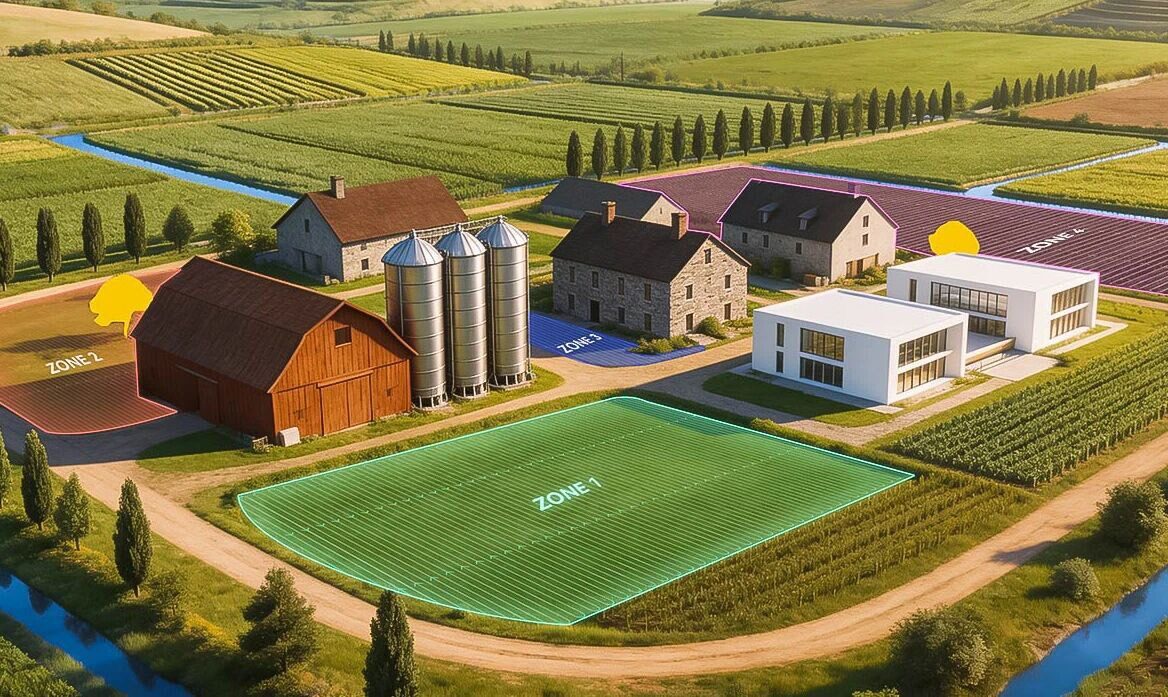
A commercial autonomous mower is not a consumer mower made larger. The core of the machine is a low-speed autonomous driving system, built around RTK-GNSS satellite positioning at ±2 cm, paired with LiDAR for real-time obstacle detection. Working blocks and no-go zones are defined with patent-backed electronic-geofence virtual walls, drawn on the controller — no boundary wire is buried, so nothing has to be cut or repaired when you till, replant or reconfigure a site.
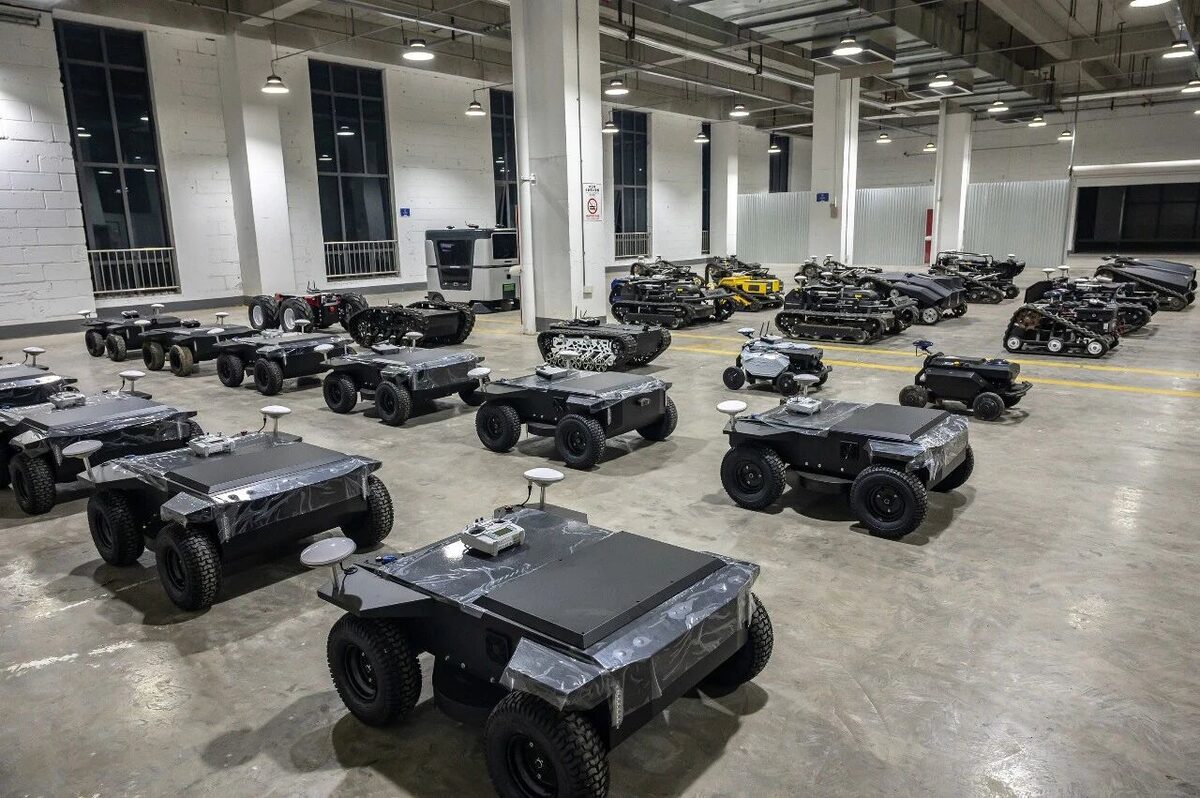
Once a block is defined, the machine plans its own coverage and follows it pass after pass. Supported patterns include boustrophedon (back-and-forth) rows, perimeter-then-infill coverage, custom routes and an orchard mode for work between rows. LiDAR detects trunks, stones, equipment, visitors and animals in the path and reroutes dynamically around them. From the app, an operator can manage multiple machines, set geofences and exclusion zones, and resume a job from its exact breakpoint after an interruption. When a battery runs low, the machine returns to its dock and continues after charging — autonomy for the routine, with a remote manual override kept for moving between blocks or unusual corners.
The R1: electric wheeled efficiency for open, level ground
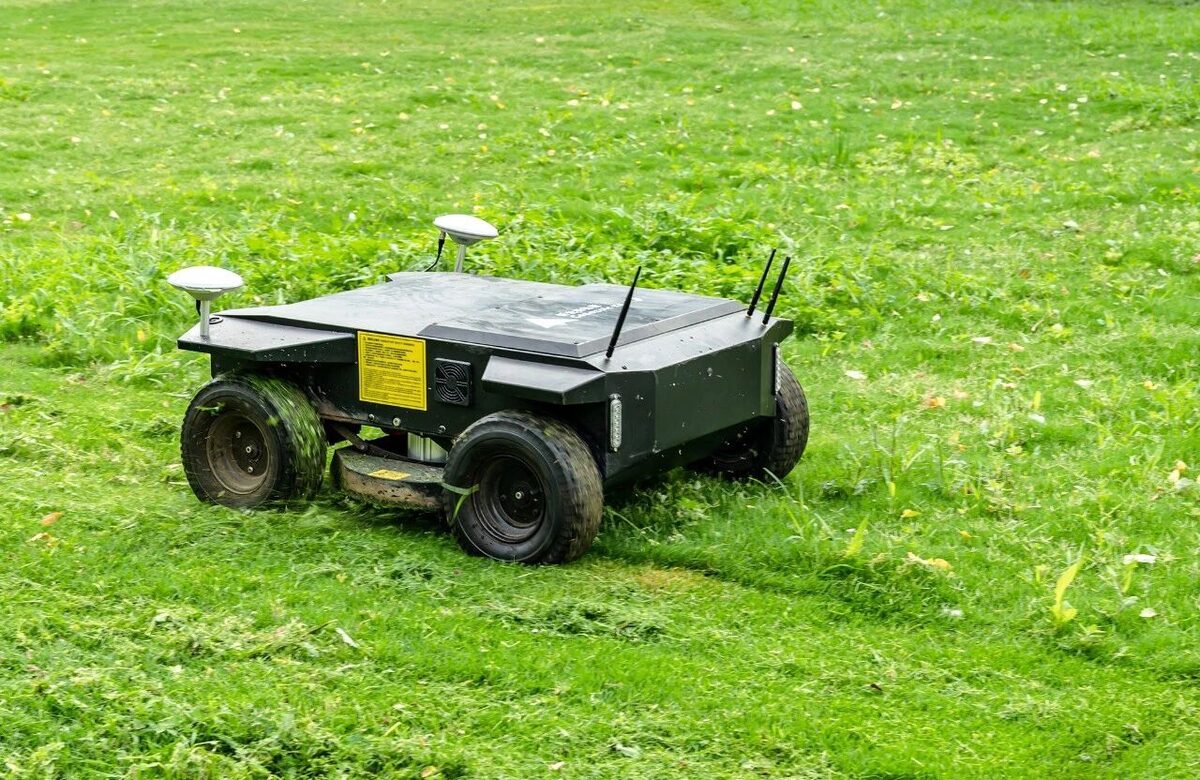
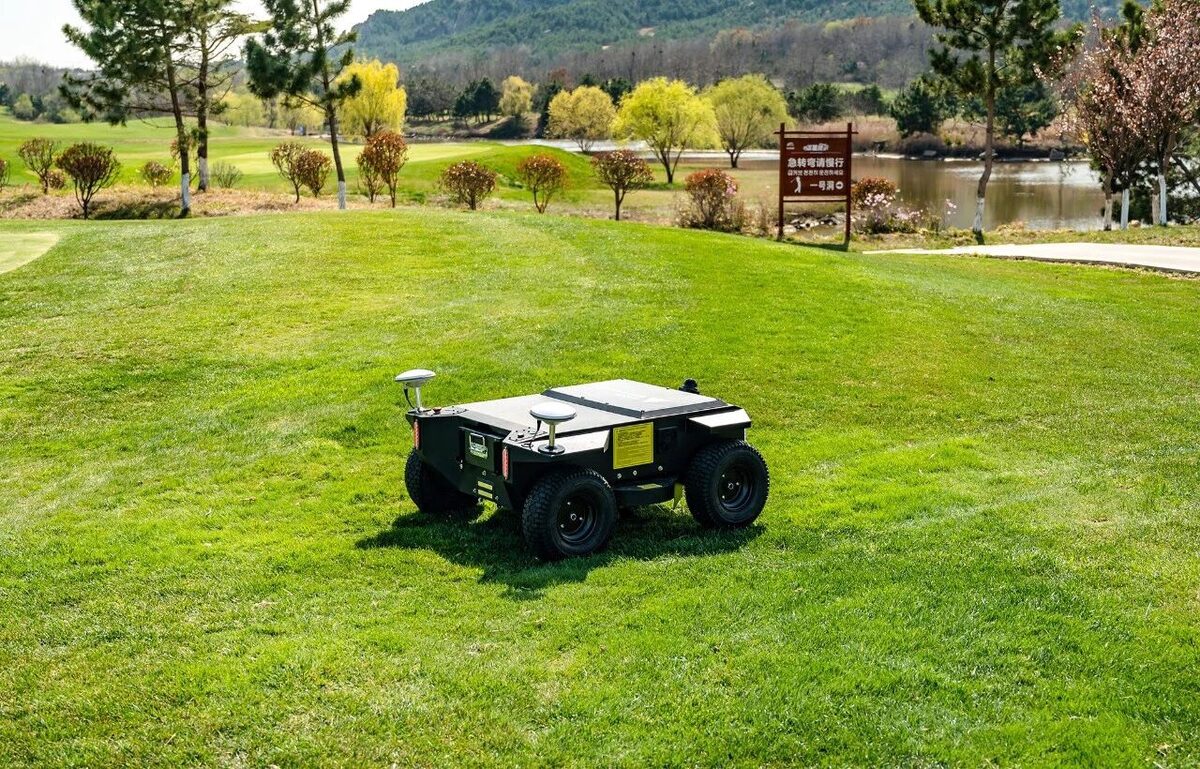
On smooth, maintained surfaces the limiting factor is access to nothing — the job is about consistent throughput with minimal disturbance. The R1 is built for that world: a pure-electric wheeled platform with a wide cutting deck, quiet operation and zero on-site emissions. Four-wheel servo drive with in-situ zero-turn lets it pivot on the spot, which matters around park furniture, field edges and the corners of a sports pitch.
- 790 mm cutting width with twin cutting motors; cutting height 20–100 mm
- Rated output around 2,000 m²/h; roughly 2 hours / 4,000 m² per removable LiFePO4 pack
- 118 kg, 4WD servo drive, in-situ zero-turn — one person can trailer and deploy it
- RTK-GNSS ±2 cm, LiDAR avoidance, electronic geofence, auto-dock and breakpoint resume
- IP54, pure electric, zero emissions — quiet enough for daytime work near housing or visitors
Because it runs on wheels, the R1 moves fast over level ground and keeps a uniform stubble height without scuffing the turf. Its packs are removable rather than hot-swappable, so operators plan spare packs for a full day away from the charger. The short version: ground that is flat, large, clean and noise-sensitive points to the R1.
The T1-900A: tracked traction for slopes and rough terrain
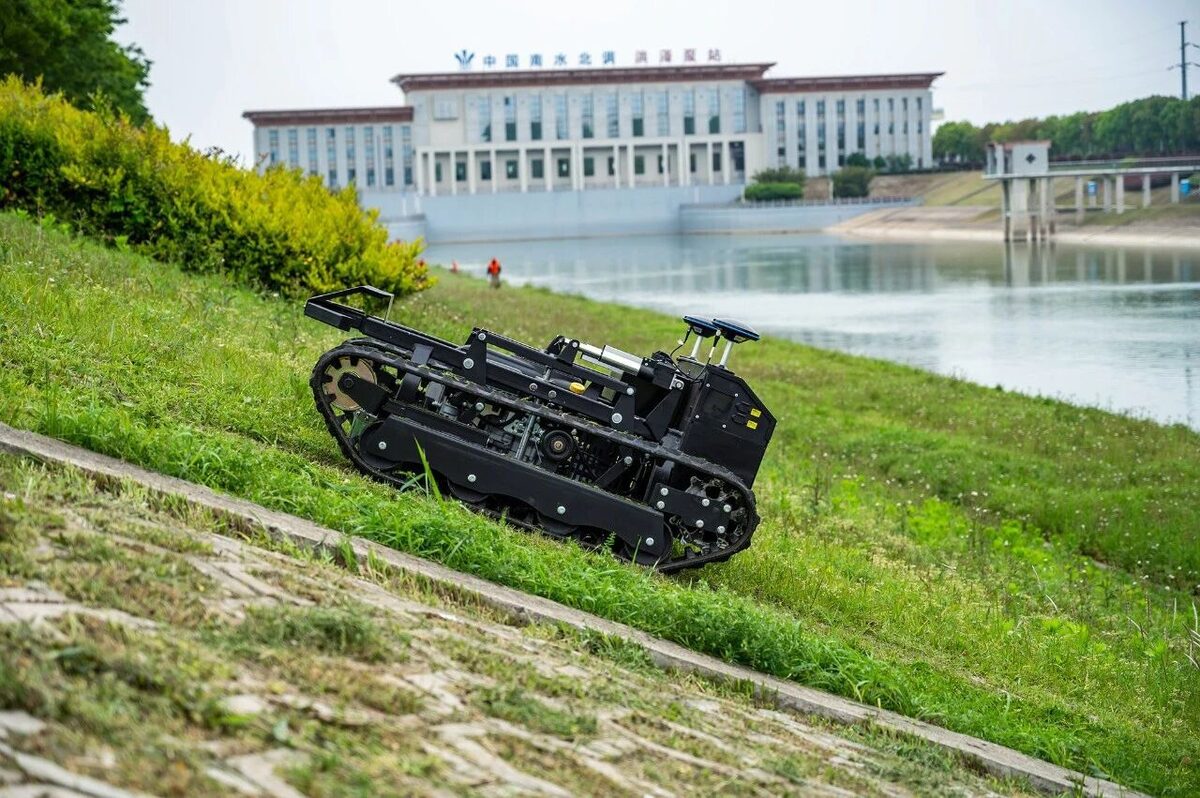
Before a machine can cut difficult ground, it first has to get onto it and stay on it. Orchard slopes, farm headlands, dam walls and river embankments combine gradient, wet grass and rutted surfaces — exactly the conditions where a wheeled ride-on can spin, slide or tip. The T1-900A answers with a tracked chassis: rubber tracks spread ground pressure to resist rutting, grip slopes up to the machine’s rated limit, and carry a 900 mm deck that accepts a flail head for tall grass and brush or a straight blade for a cleaner finish.
- 900 mm deck, flail or straight blade, for rough re-growth or open turf
- Slopes up to 40° on embankments, ditches and pads — low ground pressure resists rutting and slippage
- 3,000–4,000 m²/h fleet-capable throughput; 325 kg
- Hybrid drive: 48V LiFePO4 pack (around 2.5 h) with an optional engine for long runs on remote blocks
- The same RTK-GNSS, LiDAR, geofencing and remote supervision system as the R1
On a slope, the safety logic is as important as the traction: instead of sending a worker up with a brush cutter — with heat, slips and powered-line exposure — the machine walks the bank itself while the operator supervises from level ground. Ground that is sloping, rutted, muddy or crowded with infrastructure points to the T1-900A.
Scene by scene: which chassis fits
The same site can contain more than one answer — level orchard rows may suit the R1 while the block slopes go to the T1-900A. The table below matches common scenes to the chassis that handles them best, using the terrain rather than the label as the deciding factor.
| Scene | Terrain characteristics | Recommended chassis | Key value |
|---|---|---|---|
| Orchards | Row spacing varies; uneven grass height | T1-900A on slopes, R1 on level rows | Orchard-mode routing and LiDAR rerouting around trunks |
| Farms | Headlands, re-growth, soft and rutted ground | T1-900A | Tracked traction without getting bogged; flail mulching |
| Municipal lawns | Level, high appearance standards | R1 | Wide uniform cut, quiet daytime operation near residents |
| Golf & sports fields | Large open turf, noise-sensitive | R1 | Zero emissions, repeatable lines, multi-machine coverage |
| Solar sites | Narrow inter-row corridors, cables and exclusion zones | R1 (with geofenced corridors) | Precise paths keep the machine off cabling and panel structures |
| Reservoirs & river embankments | Angled, potentially wet grass faces | T1-900A | Tracked grip holds the slope; crew stays off the bank |
Solar vegetation work deserves one note: the deciding detail is corridor width and cable layout, not the name of the site. Rows wide enough for the 790 mm deck with clearly mapped exclusions suit the R1; sites with pronounced grading, access ramps or rough perimeters add T1-900A units. Our solar PV vegetation management page covers the layout requirements in full.
The commercial case: less risk, less cost, more consistency
Buying a commercial autonomous mower is not about novelty. Operationally it rests on three things:
- Lower risk — keep people off steep banks, away from powered infrastructure and out of the hottest shifts.
- Lower labor cost — one supervised machine covers work that would occupy several crew members, and it can run outside normal hours.
- Consistent results — the same cutting height and the same repeatable route on every cycle, instead of varying with who operated the machine.
That is the logic of the two-chassis range. It is not one machine pretending to do every surface; it is one proven autonomy system deployed on the chassis each scene actually needs. Level turf goes quietly to the R1; steep and rough ground goes to the tracked T1-900A; mixed operators run both on the same fleet software. More on the labor-hour math is in our cost-vs-manual breakdown, and the slope safety case is detailed in the embankment guide.
Quick answers
How can the same system cover so many different sites?
Mapping, RTK-GNSS navigation, LiDAR avoidance, geofencing and fleet control are shared; only the chassis changes. The wheeled R1 fits level maintained ground, while the tracked T1-900A fits slopes and rough terrain.
Can one orchard need both machines?
Yes. Level, maintained rows suit the R1, while block slopes, terraces and rough headlands suit the T1-900A. Both operate on the same maps and fleet software.
What slope can the tracked T1-900A handle?
It is rated for slopes up to 40° on embankments and similar faces, supported by low-ground-pressure tracks. Site-specific gradient and surface conditions should still be checked during planning.
Do these mowers need a boundary wire?
No. Working areas and no-go zones use electronic-geofence virtual walls set on the controller, so there is no wire to bury or later cut through.