The T1-900A tracked hybrid mower keeps vegetation down under and between panel rows and across wind site pads — a 900 mm flail-capable deck, rubber tracks that hold slopes up to 40°, and 3,000–4,000 m²/h of fleet-capable throughput. RTK-GNSS mapped routes with no boundary wire, LiDAR obstacle avoidance and remote fleet supervision, built for utility-scale plants, distributed commercial arrays, agrivoltaics and wind corridors.
Grass under and around arrays grows all season. Left unmanaged, it becomes a generation, safety and warranty issue — and the standard ways of cutting it all have a weak spot on an energy site.
Tall weeds under and between panel rows shade the lower edge of modules and create hotspots. Even partial shading across a string pulls output down, and the loss repeats every day the grass stays long.
Dry grass and brush around racking, combiner boxes and DC cabling are a recognized ignition and fire-spread hazard around energized electrical equipment — and a question insurers and O&M auditors ask about.
Hand crews with brush cutters and ride-on tractor mowers mean operator wages on repeat visits all growing season, scheduling around weather and inspections, and labor that gets harder to source every year.
Berms, drainage swales and hillside arrays defeat wheeled ride-on decks, low panel edges rule out tractors in places, and line trimmers throw stones that can chip module glass and damage backsheets — damage that turns a mowing budget into a claims problem.
The tracked T1-900A is the primary machine for the rows, embankments and rough growth; the wheeled R1 electric supplements the flat, manicured areas on the same site. Both share one autonomy package and one workflow.
Mowing routes are mapped along the array rows with centimeter-level ±2 cm positioning — no boundary wire to bury. The T1 follows consistent passes between rows, keeps a set margin from racking posts, and resumes from the exact breakpoint if a job is interrupted.
Working areas and no-go zones are set with our patent-backed electronic-geofence virtual-wall technology — drawn on the controller, no cable under the arrays. Keep mowers inside the block and out of inverters, cable trenches and exclusion areas.
LiDAR detects and reroutes around racking supports, combiner boxes, trenches, cable runs and site personnel in real time — no bumping, no impact on equipment. The flail deck mulches clippings in place instead of throwing loose stones, and the tracked platform runs at low ground pressure, so it works close to modules with far less risk than a ride-on deck.
Energy sites are rarely flat — graded berms, drainage swales, hillside arrays and wind turbine pads all feature. The T1-900A’s rubber tracks hold embankments, ditches and pads up to 40° where wheeled mowers tip or spin, with low ground pressure that resists rutting on wet ground.
The wide 900 mm cutting deck takes a flail head for tall grass, brush and rough re-growth, or a straight blade for a finer finish on open inter-row turf — so the same machine handles season-long rough growth and the manicured passes inspectors expect.
The T1-900A runs hybrid-electric drive: a 48V LiFePO4 pack with around 2.5 hours of battery mowing and an optional engine for extended runs on remote sites — long endurance on large plants without a return-to-base stop.
One supervisor oversees the site via the large-screen remote with live camera feed and manual override, plus app-based fleet monitoring with alarms. Multiple machines run in parallel across large plants, each on its own geofenced block, with spare-parts support at a 72-hour response.
If it is a structured array with grass between rows, an autonomous mower can take the vegetation cycle off your crew’s hands. The same tracked platform also covers wind turbine pads, access roads and right-of-way corridors.
Large plants with long array rows, hectares of inter-row grass, berms and drainage swales are the T1-900A’s core job: planned routes, geofenced blocks and multi-machine coverage keep the whole site on a fixed mowing cycle with a small supervision crew. The same machine maintains wind turbine pads and access corridors.
Ground-mounted arrays at factories, logistics parks and commercial premises need tidy vegetation for inspections, site image and fire safety. The tracked T1 handles the array blocks and perimeter rough ground, while the quiet, zero-emission R1 wheeled electric mower finishes office lawns, amenity turf and flat access roads.
Where panels share the land with grazing or crops, controlled grass height matters for both the array and the land use. The T1’s flail deck takes taller grass and rough growth on a precise, repeatable schedule under and around the panels, with the wheeled machines for level cultivated headlands.
One crew, one autonomy package — the fleet splits the work by terrain instead of forcing one platform across the whole site.
Tracked autonomous mower cutting tall, unmanaged re-growth on an open site — no boundary wire, supervised remotely. Click to play.
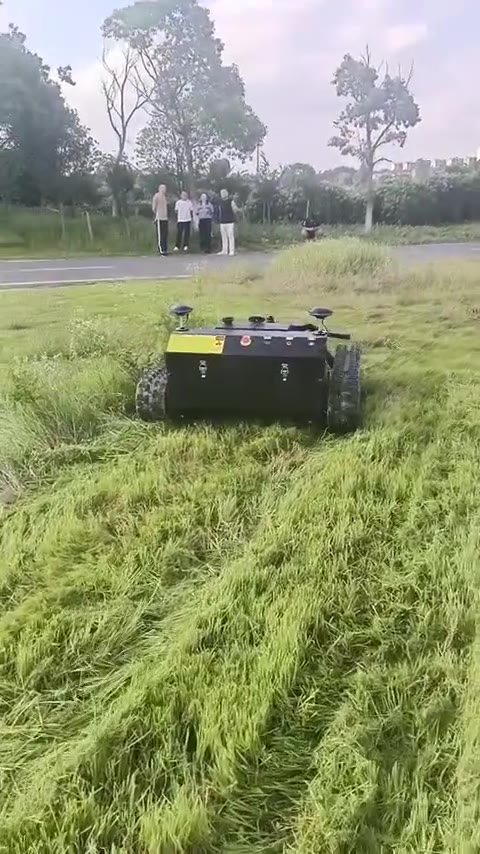
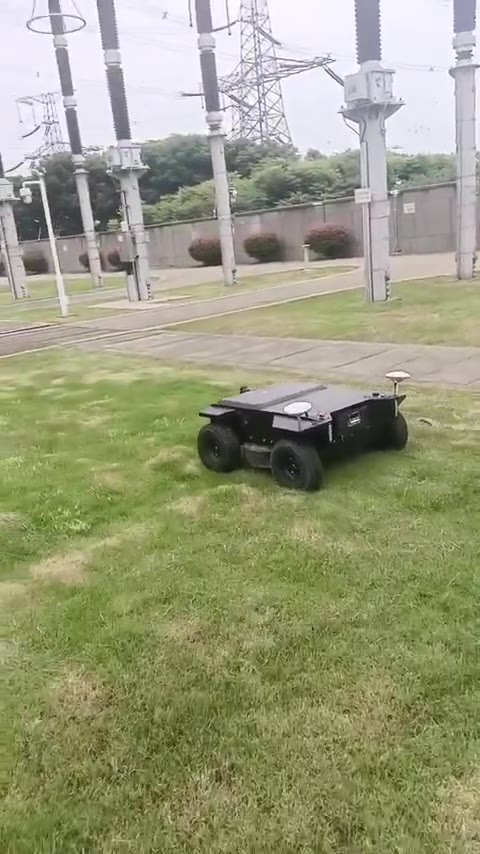
Orchard, greenhouse and steep-embankment footage is available on our orchard mowing guide and slope mowing guide.
Our field guide walks through why energy-site O&M requires regular mowing, how the traditional cost stack (hand crews, ride-on mowers, grazing) compares, and what to check — row clearance, spacing, slopes, RTK signal and geofence setup — before you specify machines. Read Robotic Mowers for Solar Farm Vegetation Management: An O&M Cost Guide, or see the full machine line on the autonomous mowers page. Questions on deployment? The Buyer FAQ covers slopes, coverage and fleet sizing.
Send us your site area, panel row spacing, terrain (slopes, embankments, brush) and country — we’ll recommend the T1-900A / R1 fleet mix, provide full specifications, and quote machine and pack counts for your vegetation cycle.