
TL;DR
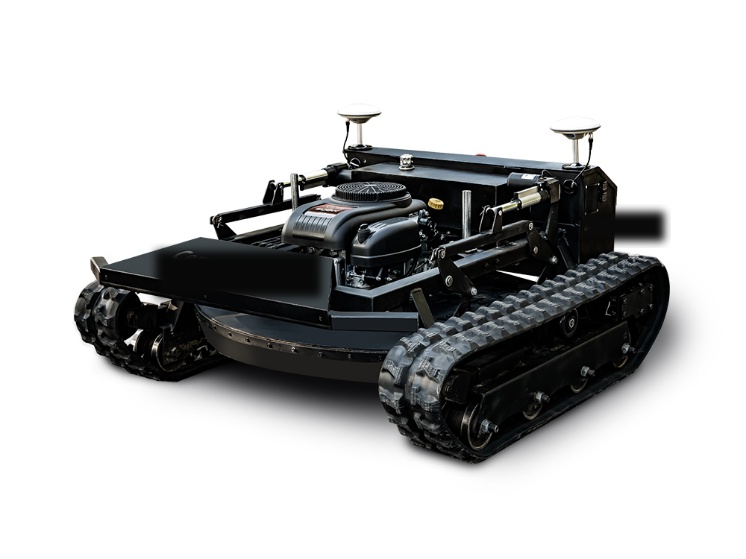
Vegetation under solar arrays must be cut all growing season — for generation, fire safety and warranty compliance. Hand crews and ride-on mowers carry recurring labor cost and real limits around slopes, low panel clearance and flying debris. The T1-900A tracked hybrid is the primary machine for rows, berms and rough growth — 900 mm deck, up to 40° slopes, 3,000–4,000 m²/h — with the wheeled R1 on flat areas, unmanned on RTK-GNSS routes.
Why solar farms have to mow — again and again
A ground-mount solar plant is, structurally, a field with a roof on it. Grass under and between the rows grows as in any open field — faster, often, because rain runoff concentrates along the rows. Owners cannot stop mowing after commissioning, for three hard reasons.
Shading kills generation. Tall weeds beneath the lower edge of modules cast partial shade across cells. Partial shading on a string does not reduce output proportionally — it can pull the performance of an entire string down while the shaded cells run hot. The effect is small on any single day and large across a growing season of missed cuts.
Dry vegetation is a fire hazard. When grass cures and dries around racking, combiner boxes and DC cabling, it becomes fuel next to energized equipment. Vegetation clearance around electrical infrastructure is a standard fire-prevention requirement, and it comes up in insurer audits and O&M inspections.
Warranty and O&M contracts demand it. Most operations and maintenance agreements set vegetation-height requirements around arrays. Sites that let growth run wild face inspection findings, and overgrown access rows slow emergency response and thermographic surveys. Vegetation management is not landscaping on a solar site — it is scheduled electrical-asset maintenance.
What the traditional options actually cost
The vegetation budget on a solar plant is dominated by one line: labor, repeated all season. Every conventional method puts people on the site for every cut.
Hand crews with brush cutters
Line trimmers and brush cutters can reach anywhere a person can walk, which is why crews still handle tight areas around racking posts and inverters. The trade-off is throughput per worker-hour is low, the work is hot and hard to staff, and trimmers throw stones and gravel — a genuine risk of chipped module glass and backsheet damage around millions of dollars of panels.
Ride-on and tractor mowers
Tractor-mounted or ride-on mowers cover open inter-row space quickly — where they can fit. Low panel edges, tilted arrays and tight headlands leave areas a deck cannot safely reach, and heavy machines on wet ground create ruts and compaction. They also need a licensed operator on board for every pass, every visit.
Grazing
Sheep grazing is popular on large plants in some markets and works well with the right fencing and water supply. It is not free: animals need shepherding, predator control, water and supplemental feed, and grazing height is uneven — sites usually still need mechanical mowing around equipment and during periods when grazing cannot keep up with growth.
Across all three, the cost shape is the same: a recurring crew expense that scales with area and visits, not a one-off capital item. Our robotic versus manual mowing cost breakdown runs the labor math in detail.
Why a robotic mower fits a solar array
Solar sites are close to an ideal autonomous-mowing environment: structured rows, fixed boundaries, repetitive area, no public traffic. The T1-900A tracked hybrid is the primary machine for that geometry — and for its rough, sloped parts.
- RTK-GNSS row navigation at ±2 cm, no boundary wire. Routes are mapped along the rows with centimeter positioning; the T1 holds a set margin from racking posts and resumes from the exact breakpoint after dock recharging.
- Electronic geofence work zones. No-go zones — inverters, cable trenches, exclusion areas — are drawn on the controller with patent-backed virtual-wall technology; nothing is buried under the arrays.
- LiDAR avoidance, low-impact tracks. The machine reroutes around racking, combiner boxes, trenches and people in real time. At 325 kg on rubber tracks it runs at low ground pressure, and the flail deck mulches clippings instead of throwing stones.
- Hybrid drive with a 48V LiFePO4 pack and optional engine. A pack runs around 2.5 hours, and the engine extends remote runs away from mains power — large plants keep moving without a return-to-base stop.
- 900 mm flail or straight-blade deck. A flail head takes tall grass and brush between rows; a straight blade gives a finer finish — one machine covers rough growth and inspection-ready turf.
- Fleet operation with remote supervision. Multiple mowers run in parallel across blocks, overseen by one supervisor with the large-screen remote, live camera and app-based fleet monitoring.
On sloped and uneven terrain — berms, swales, hillside arrays, wind turbine pads — the tracked T1-900A holds slopes up to 40° where wheeled mowers tip or spin; our slope mowing guide covers the embankment logic. Flat, manicured zones such as office lawns and level access roads go to the quiet, zero-emission wheeled R1 (790 mm, 2,000 m²/h, 118 kg). Full fleet logic is on the solar & wind site vegetation management page.
What to check before you specify machines
Not every plant is ready for autonomous mowing on day one. These are the five things we check in a site assessment:
- Under-panel clearance. Measure the lowest module edge and tilt range. The mower works the inter-row space primarily; confirm what must be cut by hand or a reach tool.
- Row spacing and headlands. The T1 runs a 900 mm deck and turns on its tracks; headlands still need U-turn room and clean geofence corners. Narrow fenced gaps go to the compact 450 mm R3.
- Terrain and drainage. Map swales, berms, ditches and washouts. The tracked T1-900A holds those sections up to 40°; wheeled machines stay on flat, graded ground.
- RTK signal coverage. Centimeter navigation needs a clear sky view — inter-row corridors have it, though steep north-facing arrays may need base-station planning.
- Fleet sizing. Count area and required cuts against the T1’s 3,000–4,000 m²/h and ~2.5-hour pack cycle, plus optional engine runtime for remote blocks.
Buying advice for O&M teams and dealers
Treat the purchase as any O&M equipment decision: verify real mass production, not a prototype; confirm CE, EPA Tier 4 and EURO V paperwork; and — most important for unmanned equipment — pin down spare-parts response. WANJI commits to 72-hour parts response; an autonomous mower waiting on a blade bolt produces nothing.
Match the machine to the zone: rough terrain, slopes and brush call for the tracked hybrid T1-900A — 900 mm flail-capable deck, 40° slopes, 3,000–4,000 m²/h and hybrid endurance for remote blocks. Flat, lawn-style areas — office lawns, amenity turf, level access roads — go to the quiet, zero-emission wheeled electric R1 at 2,000 m²/h, with the compact R3 for tight-access spots.
For dealers, solar vegetation management is a fast-growing application on top of an agricultural robotic-mower business — same machines, same training, same parts pipeline. Our supplier selection guide covers what to verify before signing a territory, and the Buyer FAQ answers pricing, slope and coverage questions. Ready to size a plant? Request a quote with your area, row spacing and country — we will recommend the machine and pack count and quote within 24 hours.