Every property manager with a dam, a levee, a roadside embankment or a steep hillside knows the same problem: the grass has to be cut, and nobody wants to drive on it. Steep slope mowing is the most dangerous routine job in grounds maintenance — and it is the job a slope mowing robot was built to take off the operator. Here is how these machines work on embankments, what a “40-degree slope” rating really means, and how to specify an embankment mower you can trust.
Why steep slopes are the most dangerous place to mow
Ride-on mowers on inclines are a rollover waiting to happen. Weight transfer shifts traction uphill, one wet patch or rodent hole can break grip, and once a machine slides sideways the operator usually cannot correct it. Industry guidance tells crews to mow up-and-down, not across the face, to stay off slopes at the edge of the rating, and to skip wet conditions — which is why embankment mowing is always behind schedule.
Access is the second problem. A 40° face is often unreachable by tractor, so crews default to hand-held brush cutters on a rope: slow, exhausting, still risky. A tracked embankment mower reverses the equation — the machine goes on the slope, the operator stands safely at the top with a remote.
Tracks vs. wheels: why slope work needs a tracked platform
Wheels concentrate weight in small contact patches. Rubber tracks spread the machine’s weight across a far larger footprint: lower ground pressure, far better grip on grass and damp clay, and traction that does not vanish as the slope steepens — the same reason excavators run on tracks.
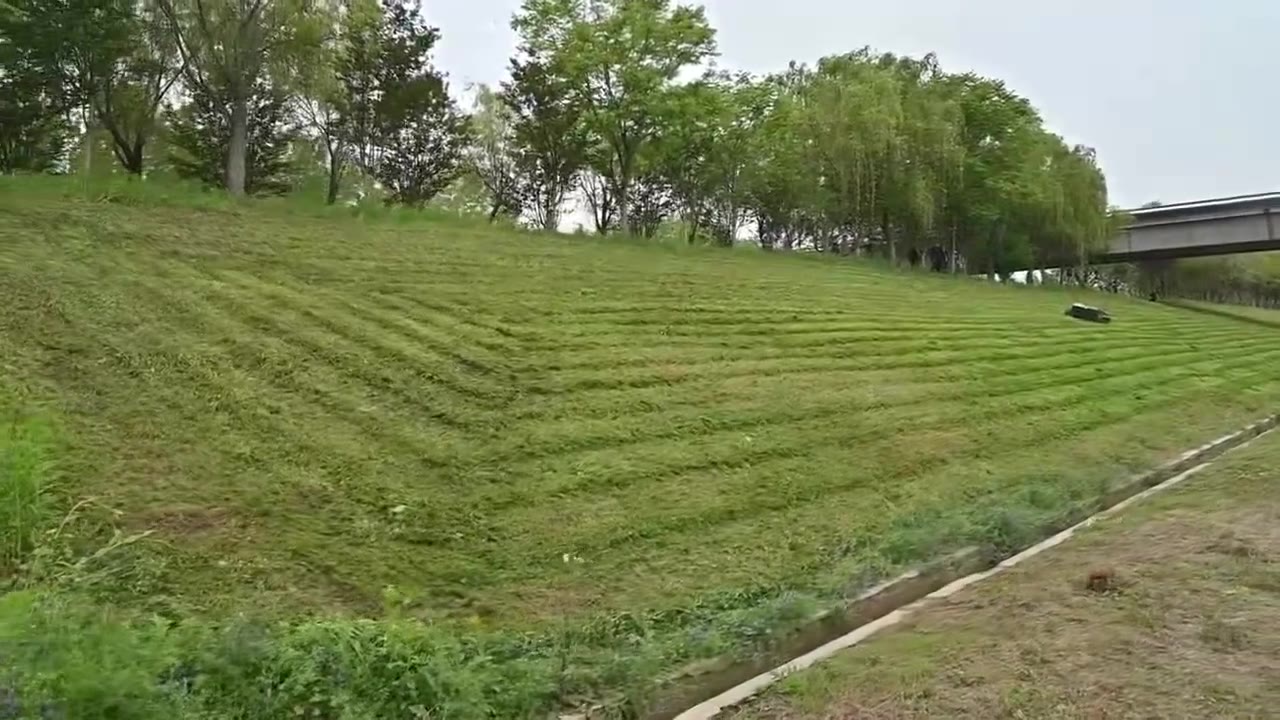
WANJI’s slope-duty machine is the T1-900A tracked hybrid mower: a 900 mm cutting-width platform on rubber tracks, rated for slopes up to 40°. Hybrid power — a 48V LiFePO4 battery with around 2.5 hours of battery running plus an optional engine for extended work — keeps it cutting all day. Our wheeled platforms are not slope tools: the compact R3 is rated to 20°, and the wheeled R1 belongs on orchards, estates and municipal ground. Match the tool to the terrain.
- Slope rating up to 40° on rubber tracks — embankments, dams, levees, roadsides
- 900 mm cutting width, working output 3,000–4,000 m²/h
- Hybrid drive: 48V LiFePO4 battery, ~2.5 h battery running, optional engine for extended shifts
- RTK-GNSS (±2 cm) + LiDAR navigation and obstacle avoidance on the same autonomy stack as the wheeled line
- Operating weight 325 kg — trailer-sized, deployable by a small crew
How the machine stays on the slope — and stays safe
Autonomy on an embankment uses the same stack as on the flat. RTK-GNSS positioning at ±2 cm lets the machine follow planned paths across the face with no boundary wire — our patented electronic-geofence virtual walls keep it inside the work zone and away from the crest, the toe, roads or water. LiDAR obstacle avoidance detects people, animals and debris in real time and reroutes or stops, which matters where walkers and dropped branches are routine.
The operator stays in command through the 7-inch touchscreen remote with live camera feed and manual override: if the machine approaches terrain you do not like — soft ground at the toe, a washed-out patch — you take over from the top of the bank. The fleet dashboard shows where every machine is and what it has cut. Nobody rides the slope — that is the whole safety case.
Where slope mowing robots actually work
- Dam and reservoir embankments — grassed faces kept short for inspection and erosion control on fixed cycles.
- Roadside and highway verges — steep back-slopes behind ditches where arm-mounted flails struggle.
- Levees and flood defences — long linear embankments ideal for autonomous route planning, crest and face in one run.
- Hillside orchards and vineyard terraces — blocks where wheeled tractors should not go; see our orchard mowing guide.
- Solar farms — vegetation under and around panel arrays on graded, sometimes steep ground.
For municipalities and contractors bidding this work, the cost side changes too: a hand-tool slope crew measures progress in hundreds of square metres per day; the T1-900A cuts thousands per hour, with no operator on the incline. The labor math is laid out in our robotic mower cost savings breakdown.
Buyer’s specification checklist for a steep slope mower
- State the actual slope angle. Measure your steepest face in the wet season, not the dry. Up to 40° points to the tracked T1-900A; gentle ground suits the wheeled R1 at 2,000 m²/h. If a “slope rating” comes with no conditions, ask for them.
- Check the safety stack, not just the drivetrain. Virtual-wall geofencing, LiDAR avoidance, emergency stop and live-video override are what keep a 325 kg machine out of trouble — see our RTK-GNSS and LiDAR guide.
- Plan power for full shifts. The hybrid platform gives battery running for normal cycles and an optional engine for long runs where charging is inconvenient.
- Verify support behind the machine. Every WANJI unit is tested before dispatch, ships with a spare-parts kit, and is backed by a 72-hour spare-parts response — slope crews cannot wait weeks for a part mid-season.
- Check paperwork for public work. CE certification, plus EPA Tier 4 and EURO V on the engine range, covers municipal procurement in Europe, North America and Australia, where WANJI machines work across 30+ countries.
Slope ratings are measured on maintained grass in reasonable conditions; wet clay, loose fill and worn tracks all reduce grip. Specify your worst-case face — steepest angle, wettest month, longest run — and we will recommend the right platform, even if that means telling you a tracked unit is overkill for your site.
Quick answers
Can the mower work fully autonomously on a 40° face?
The T1-900A is rated for slopes up to 40° and runs the same RTK-GNSS + LiDAR autonomy stack as our wheeled mowers; the operator supervises by remote with live video and can take manual control at any time.
Do we need an operator standing on the slope?
No — that is the point of the machine. The operator works from the top or the crest with the 7-inch touchscreen remote.
What does an embankment setup cost?
Quotes depend on model, quantity, destination and the spare-parts kit setup for the work zone. Send your slope angle and site length via the contact form — we reply within 24 hours. More buyer questions are in the Buyer FAQ.