
Orchard mowing is a job that never ends and never gets easier. Grass grows between the rows all season, the spaces under the canopy are too tight for most ride-on machines, and every hour an operator spends on the mower is an hour not spent on pruning, spraying or harvest. A robotic mower for orchards changes that arithmetic — but only if the machine can actually work between your trees. This is the field-level guide to what works, what the numbers mean, and what to check before you buy.
Why orchards are a hard mowing job
A flat lawn is easy. An orchard is a slalom course: tree trunks on fixed spacing, low branches, irrigation lines along the rows, netting posts, picking bins, and drainage ditches at the headlands. The grass under the canopy grows in shade, stays damp longer, and is exactly where a conventional mower deck does not reach cleanly. Crews end up mowing the centres with a tractor-mounted mower and hand-trimming under the trees — or leaving it, which invites rodents, slows harvest traffic, and looks unprofessional for pick-your-own and agritourism operations.
That combination — repetitive area, structured obstacles, and a chronic shortage of operator hours — is precisely where autonomous mowing pays off. The rows are straight, the boundaries are known, and the machine can run while the crew does skilled work elsewhere.
How an autonomous mower runs between your trees
WANJI’s orchard-capable mowers navigate with RTK-GNSS satellite positioning at ±2 cm accuracy, plan their own mowing routes, and resume work from the exact breakpoint if the job is interrupted. Working areas and no-go zones are set with our patented electronic-geofence virtual-wall technology — there is no boundary wire to bury and no wire to cut when you later till or replant. You draw the blocks on the controller, and the machine stays inside them.
Obstacles are handled by LiDAR obstacle avoidance: the sensor detects people, animals, tree trunks and debris in real time and reroutes around them instead of bumping or stopping. When you want direct control — moving the machine between blocks, mowing around a new planting, or clearing a tricky corner — the 7-inch touchscreen remote gives a live camera feed and full manual override. It is autonomous on the routine, human on the exceptions.
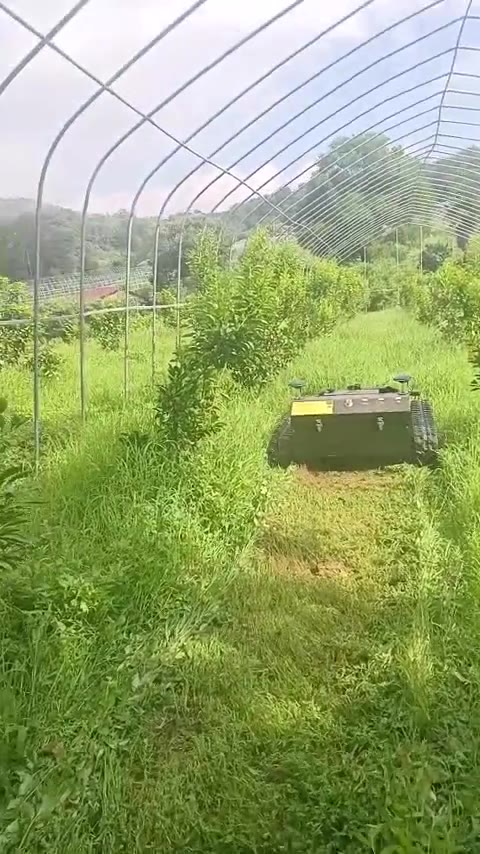
- 790 mm cutting width with twin 850 W cutting motors — wide enough for row work, narrow enough for tight headlands
- 2,000 m² per hour rated output — about a fifth of a hectare every hour, 33% more than our compact model
- 118 kg with 4WD servo drive and in-situ zero-turn — one person can trailer and deploy it
- Removable LiFePO4 battery: up to 2 hours / 4,000 m² per pack; not hot-swappable — it auto-docks, recharges (~2 h) and resumes, or a spare pack is fitted after power-off
- 20–100 mm cutting height, IP54 rated, pure electric with zero emissions
Do the area math for your own grove. At 2,000 m²/h, a 10-hectare orchard is about 50 machine-hours of mowing — work that no longer requires an operator on board. With spare LiFePO4 packs swapped through the day, one R1 can cover roughly 16,000 m² (1.6 hectares) in an 8-hour day. For larger groves or wet, hilly blocks, the tracked hybrid T1-900A rates 3,000–4,000 m²/h and climbs embankments the wheeled machines should not attempt.
What this means for your mowing schedule
The biggest operational shift is that mowing stops being a crew event. Instead of scheduling a tractor and driver for a few long days per month, the robot can mow little and often — the approach that keeps orchard grass short enough to mulch cleanly, avoids thick clumps of cut grass, and keeps the block looking maintained year-round. Because the R1 is pure electric, it can run early in the morning without engine noise or exhaust — a real advantage for orchards attached to hotels, vineyards with visitor operations, or any farm near housing. The same zero-emission profile makes the machines a fit for municipalities, airports and estates; see the full line on the autonomous mowers page.
Maintenance is simple by design: removable battery packs, no engine to service on the electric platform, and a spare-parts kit with every machine. Every WANJI unit is tested on the factory test area before dispatch, and we back the range with a 72-hour spare-parts response. The buyer-side math on labor savings — and how to calculate payback for your wage level — is covered in our robotic mower cost savings breakdown.
Buyer checklist: putting a robot in your orchard
- Map the blocks and measure the area. Total hectares, row spacing, and the share of slope over roughly 15° decide wheeled vs. tracked. Flat-to-gently-sloping groves suit the R1; embankments and steep hillsides point to the T1-900A.
- Count your daily mowing window. Match packs to area: the R1 covers about 4,000 m² per pack, so plan spare packs for a full day away from the charger.
- Check what RTK coverage looks like on your land. RTK-GNSS needs open sky; very steep hillside blocks with deep terrain shadows are worth flagging to us so we can recommend the right setup. The technology itself is explained in plain terms in our RTK-GNSS and LiDAR article.
- Verify certifications and parts support. WANJI mowers and excavators carry CE certification, with EPA Tier 4 and EURO V on the engine range — important for dealers and for any purchase going through public procurement.
- Buy from a partner that can support the machine for years. Mass production, parts kits and a stated 72-hour parts response matter far more than the demo day. Our supplier selection guide walks through the full checklist.
Quick answers
Can the mower work under low branches?
LiDAR and the touchscreen remote let the machine operate in and around obstacles; branches that physically hang into the deck still need normal pruning clearance, as with any mower.
Do I need to bury a boundary wire?
No. Working areas use patented electronic-geofence virtual walls set on the controller — no wire, and nothing to cut when you rework the orchard.
What about pricing for an orchard setup?
We quote per model, quantity and destination — including the right number of spare battery packs. See the Buyer FAQ, then request a quote with your hectare count.