WJ-T-900A Autonomous Mower
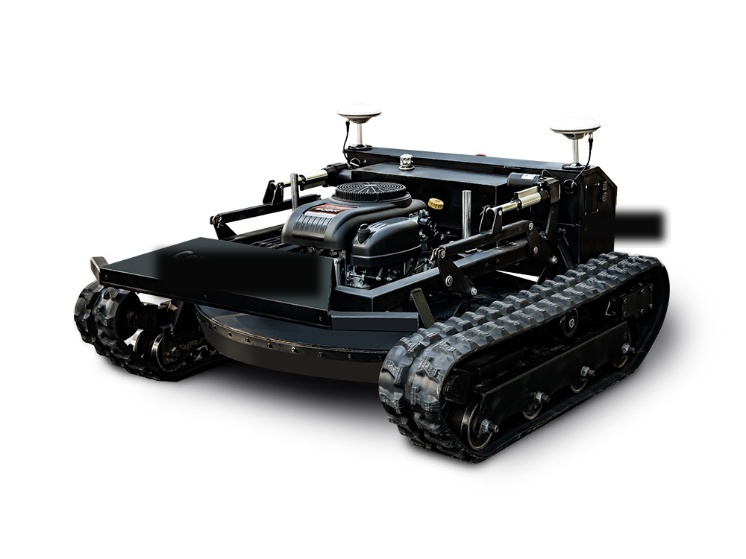
A rubber-track, hybrid-electric, fully autonomous three-blade mower built for the steep, overgrown and hard-to-reach ground where wheeled mowers cannot safely operate — embankments, dam levees, solar and wind sites, orchard and vineyard rows.
Why the T-900A holds ground other mowers cannot
The platform was designed around one constraint: keeping an operator off steep, unstable terrain. Everything else follows from that.
Rubber-track chassis, slopes up to 40°
Low ground pressure tracks stay planted on dam levees, embankments and orchard rows. No operator on board means no rollover risk to a person.
Hybrid drive — engine cuts, battery moves
The Briggs & Stratton 810cc 27 HP engine drives the three-blade deck only. A separate rechargeable pack drives the tracks, so the machine runs all day on one tank with no mains supply on site.
900 mm lifting deck, 2 swing + 1 fixed
Three blades mulch tall grass, weeds and light brush into fine clippings. Cutting height adjusts from 20 to 150 mm through the lifting deck.
RTK-GNSS, no boundary wire
Maps array rows, embankments and orchard alleys, then repeats scheduled routes without any wire buried in the ground. Path planning is developed in-house.
LiDAR fusion obstacle avoidance
Detects panels, posts, trenches, equipment, animals and people. The machine stops, reroutes, and raises an alarm on the remote and the mobile app.
Up to 8 hours on one tank
Peak efficiency of 3,000–4,000 m² per hour. A full tank covers a full working day, so a 20,000–30,000 m² embankment or solar block is a single-fuel-stop job.
Technical specification
Figures below apply to the standard WJ-T-900A configuration. Final configuration is confirmed per order.
| Platform | Rubber-track hybrid-electric, all-terrain |
|---|---|
| Cutting width | 900 mm |
| Cutting height | 20–150 mm (lifting deck) |
| Blades | 2 swing + 1 fixed |
| Blade speed | 3,000 rpm |
| Peak efficiency | 3,000–4,000 m²/h |
| Max climbing angle | Up to 40° |
| Powertrain | Briggs & Stratton 810cc 27 HP drives the cutting deck; a separate battery pack drives the rubber tracks |
| Endurance | Up to 8 h per full tank |
| Fuel tank | Issued with the per-order datasheet |
| Battery pack | Service-replaceable, charger included |
| Net weight | 339 kg |
| Travel speed | 0–6 km/h |
| Navigation | RTK-GNSS autonomous, self-developed path planning, no boundary wire |
| Obstacle avoidance | LiDAR fusion for dynamic obstacles |
| Control | Large-screen 2.4G remote controller + mobile app with alarms |
| Operation | Autonomous scheduled routes + manual remote override |
| Charging dock | Auto charging dock included |
Included with every unit: RTK-GNSS autonomous navigation with self-developed path planning, LiDAR fusion obstacle avoidance, large-screen 2.4G remote controller and mobile app with alarms, rechargeable battery pack for track drive, charger, and auto charging dock.
Where it is used
Five ground types that account for most T-900A deployments in Europe and the Middle East.
Documents
Specification, product details and the full user manual. All documents are published without pricing.
Other models in the range
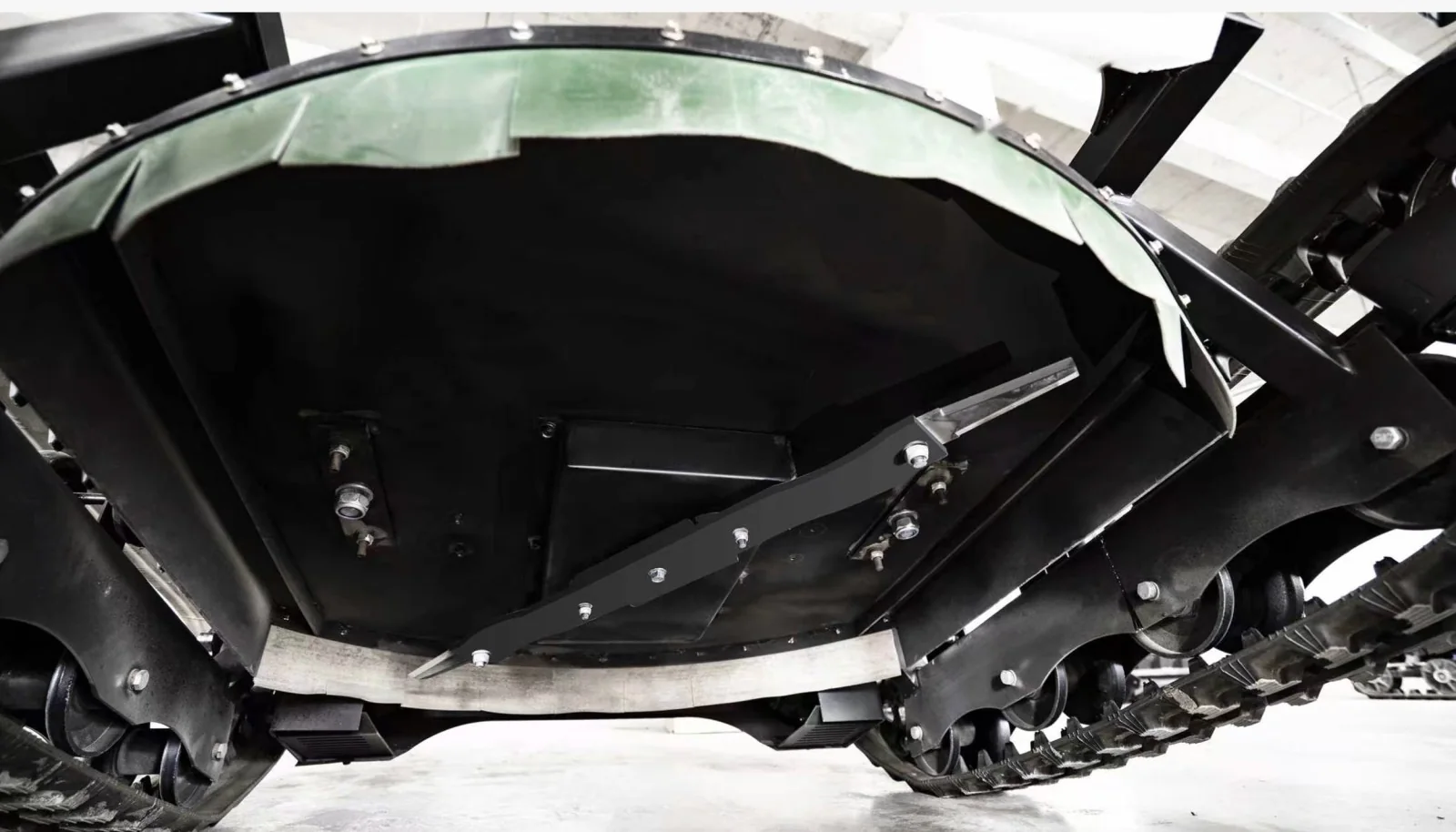
What the 900 mm lifting deck looks like underneath
The T-900A deck carries three blades — two swing blades and one fixed blade — under a pressed steel shell. Photographed on a production machine.
Frequently asked questions
Deck, fuel, drivetrain and support questions buyers raise before ordering.
What deck does the WJ-T-900A run?
A 900 mm lifting deck with three blades — two swing blades and one fixed blade — cutting 20–150 mm. The swing blades fold back when they hit stone or wire, so the impact stays out of the spindle instead of cracking the shaft.
How long does one tank of fuel last?
The Briggs & Stratton 810cc engine runs up to 8 hours per full tank, and the separate battery pack drives the tracks independently of the engine. At the rated 3,000–4,000 m²/h that covers roughly 24,000–32,000 m² per fill, so a full shift on an embankment or solar block needs no refuelling stop.
What engine drives the deck?
A Briggs & Stratton PXi 2700 V-twin — 810cc, 27.0 gross HP. It drives the cutting deck only. The rubber tracks run on a separate battery pack, so the engine never has to pull the machine's weight up the slope, and cut quality stays constant as the grade changes.
How steep a slope will it work on?
Up to 40 degrees on dry grass. That is the 900A's own rating: the wide-deck WJ-T-900M, WJ-T-1100M and WJ-T-1300M use a different chassis rated to 60 degrees, so the two platforms are not interchangeable on steep ground.
What support comes with the machine?
A 12-month full-machine warranty on core components, remote running-log diagnostics, universal parts sourced locally in the buyer's market, and engineer video support during commissioning.
Quotation, dealer terms and delivery
Pricing is configuration and destination specific, so no price list is published. Tell us your ground type, area and country and we will come back with a configuration and a quotation.