After a spell of rain, the grass at the field edge shoots up again. In the orchard, weeds climb the tree trunks; across the slope, the grass runs in one unbroken sheet. When it is young, it feels like nothing — take the machine out, walk one round, and it is done. But before long the grass is back, especially in peak growing season. What wears a farm crew down is rarely a single cut. It is knowing the next cut is already coming. This guide looks at why that cycle matters more as a farm grows, and how autonomous mowers for large farms — the electric R1 and the tracked hybrid T1-900A — let a machine finish an entire block without an operator walking alongside.
Mowing is never a one-time job
On a small area, manual work still holds up. One person with a machine walks between the trees or works slowly along a slope. But the picture changes once the land gets large. On farms measured in hundreds of hectares, orchards, slopes, woodland and newly cleared ground sit side by side. Some parts are level, some roll; some you can enter directly, others you have to work around. The grass is the same grass — only the area keeps growing, and the repeats keep coming.
Manual mowing has not disappeared. But when a large volume of near-identical work has to be done every week, it is fair to ask a different question: does all of that repeated labor have to stay in human hands, forever? Agricultural mechanization first answered how to cut — the machine did the cutting so a person no longer inched forward with a hand tool. Once positioning, navigation and route planning joined in, the machine began to face a second question: can it go by itself?
From “cut the grass” to “finish the whole block”
That is the clearest difference between an intelligent commercial mower and a conventional one. In the old model the machine cut and the person operated — where the operator walked, the machine mowed. Today, positioning, navigation and route planning open up another way of working: first define the area, then plan the route, then follow the route to finish the job. Across changing terrain, the machine moves within its own capability, while remote supervision and alarms mean a person does not have to stay at its side.
On a WANJI machine this runs on RTK-GNSS satellite positioning at ±2 cm. Working blocks and no-go zones are set with patent-backed electronic-geofence virtual walls — drawn on the controller, with no boundary wire to bury and nothing to cut later when you till or replant. LiDAR detects people, animals, trunks and debris in real time and reroutes around them. If a job is interrupted, the machine resumes from the exact breakpoint; when a pack runs low it returns to its dock, recharges and carries on. It is autonomous on the routine, with a remote manual override kept for the exceptions.
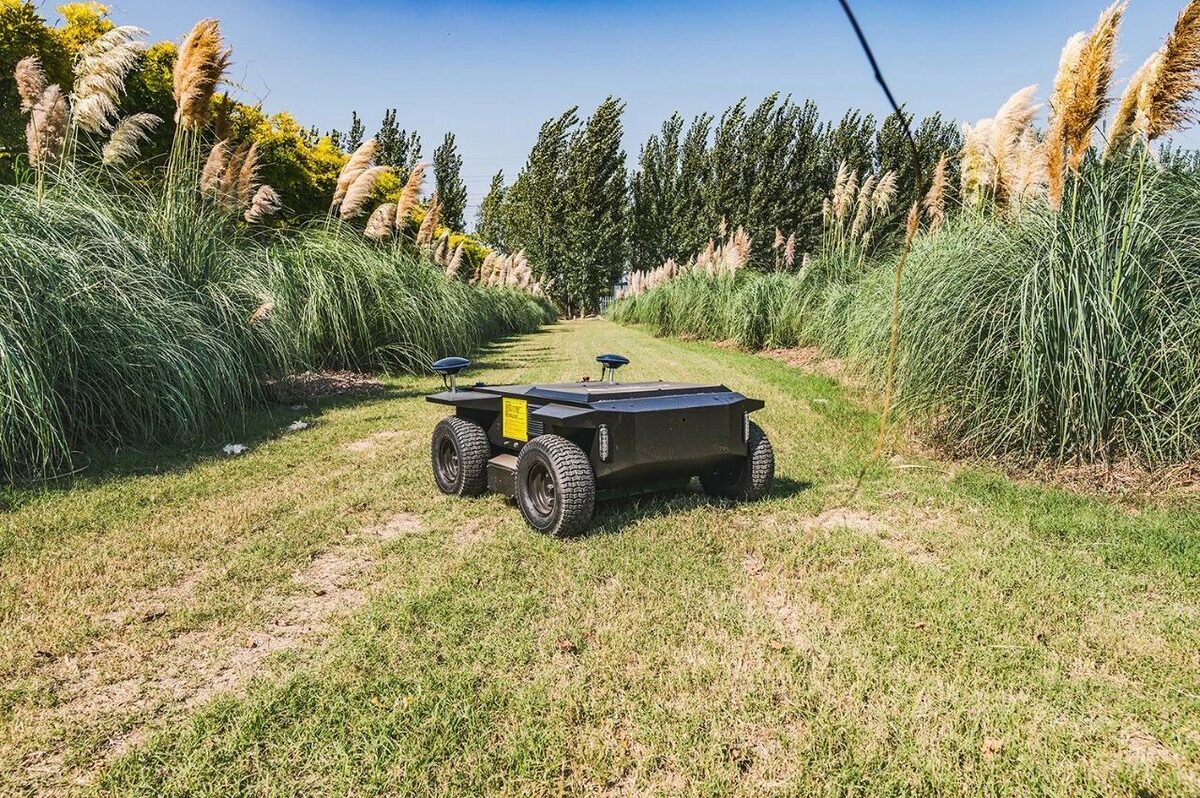
The R1: the all-electric approach
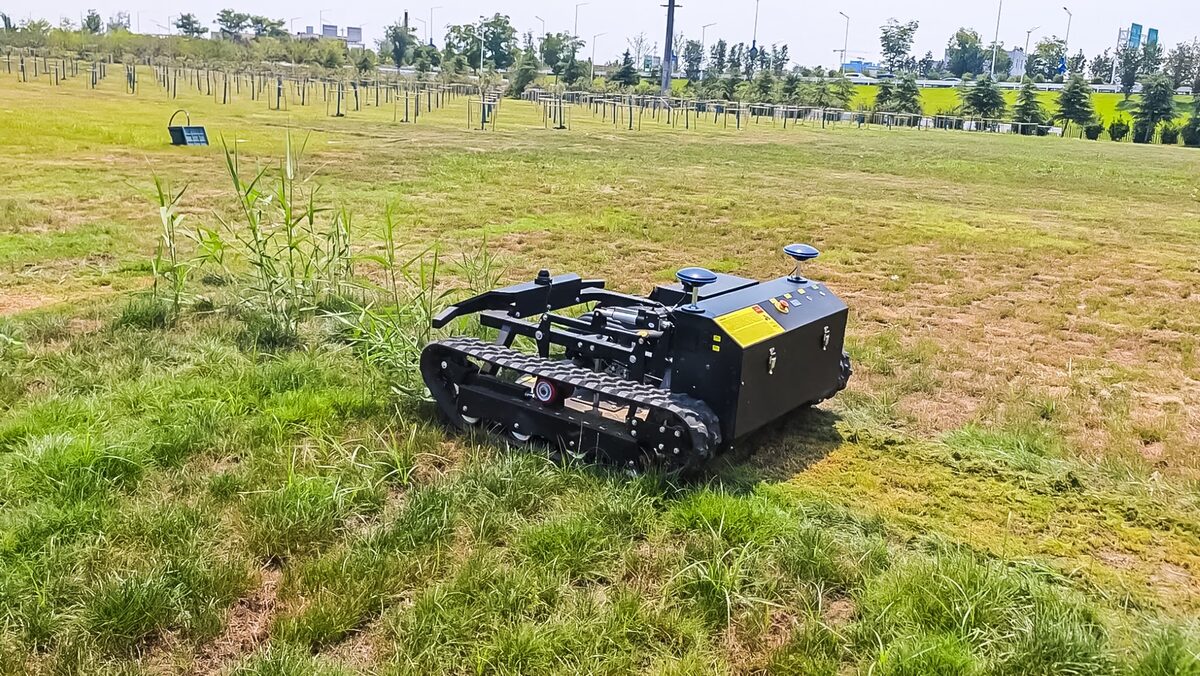
Where the tracked platform is built for access, the R1 chooses a different route — quiet, all-electric work. Instead of engine noise there is an electric drive and a removable lithium iron phosphate (LiFePO4) battery. Four-wheel servo drive with in-situ zero-turn lets it turn on the spot, and it handles small obstacles and moderate slopes within the working area. Remote control and remote alarms come as standard.
- 790 mm cutting width, twin cutting motors, cutting height 20–100 mm
- Rated output around 2,000 m²/h; roughly 2 hours / 4,000 m² per removable pack
- 118 kg, 4WD servo drive, in-situ zero-turn — one person can trailer and deploy it
- RTK-GNSS ±2 cm, LiDAR avoidance, electronic geofence, auto-dock and resume
- IP54, pure electric, zero emissions — quiet enough for early starts near housing or visitor operations
The R1 suits flatter, maintained ground and farms that put a premium on low noise and fewer operator hours: amenity turf, level orchard rows, paddocks and the manicured zones of a larger property. The battery packs are removable rather than hot-swappable, so fleets plan spare packs for a full day away from the charger.
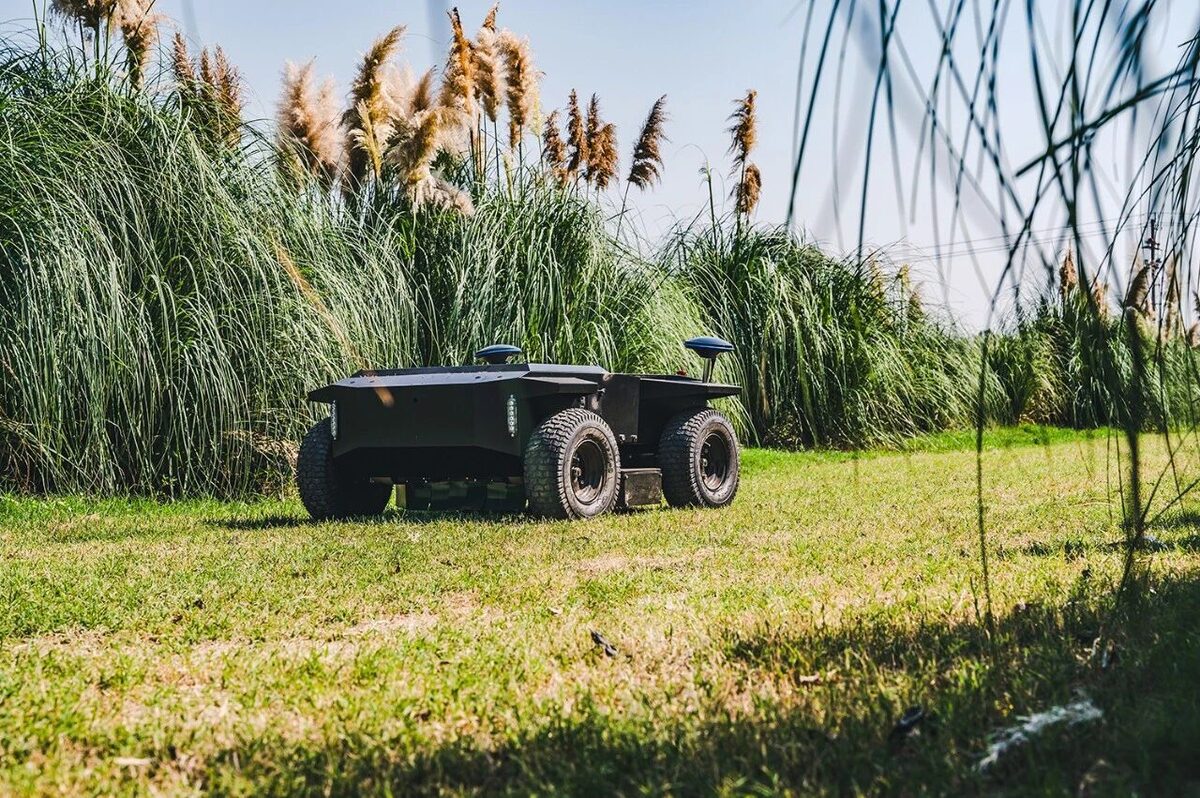
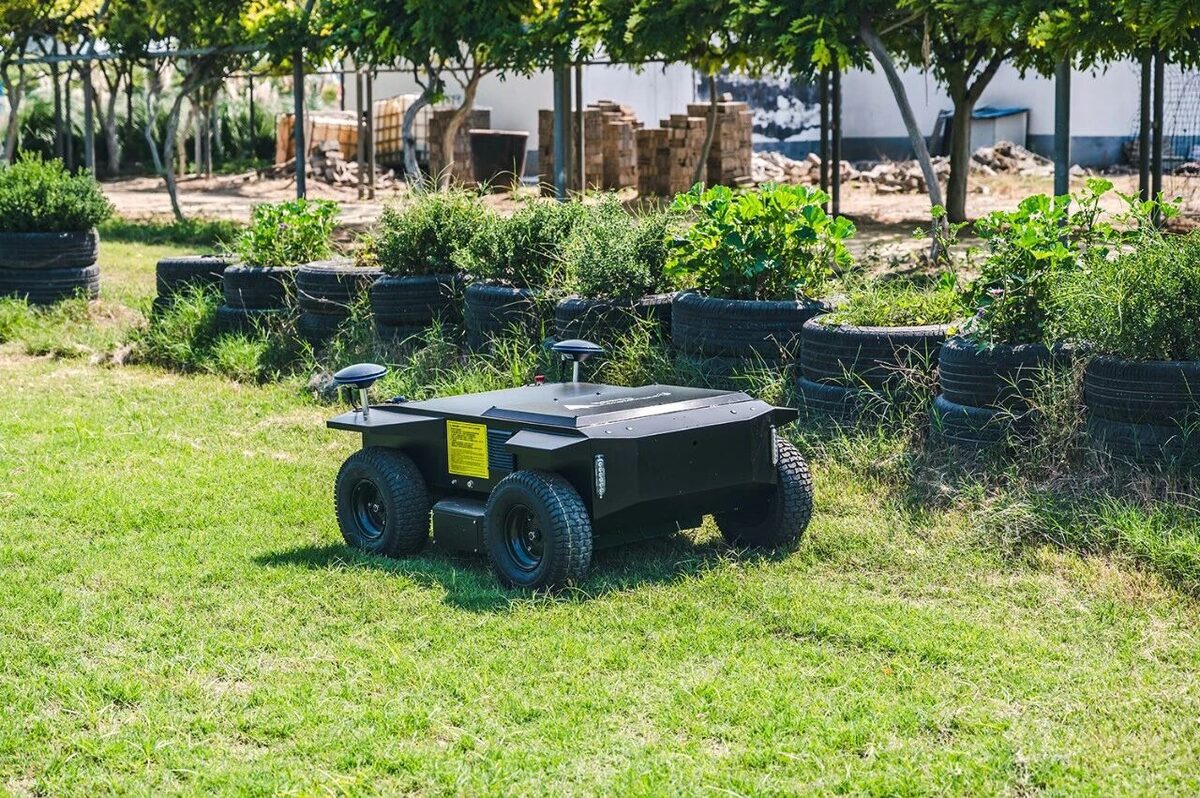
The T1-900A: first, make sure it can get in
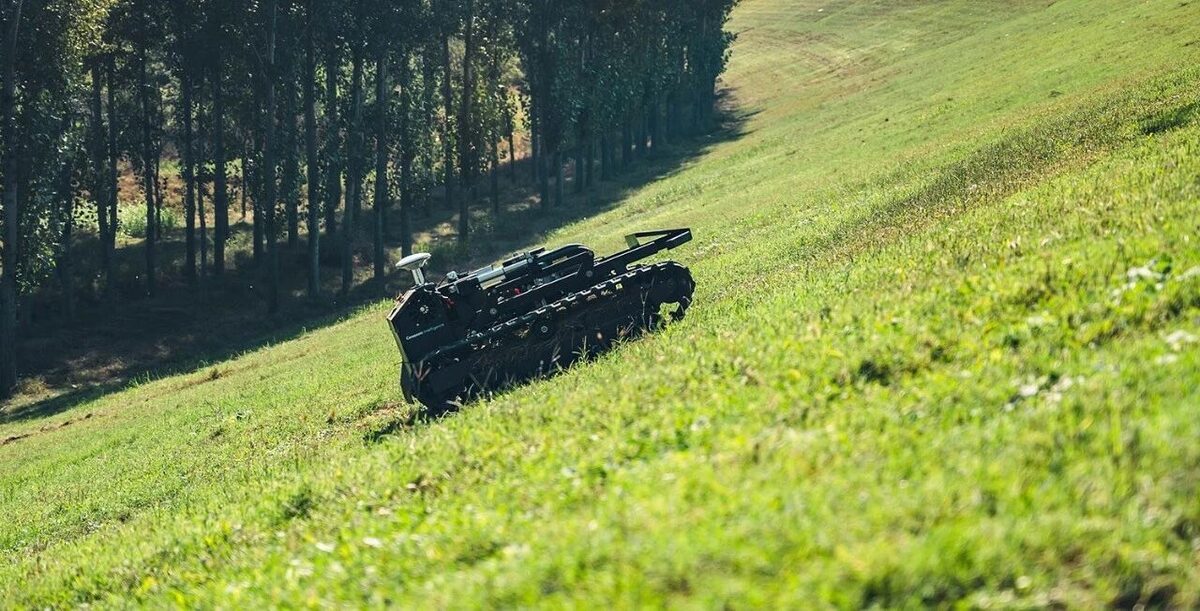
Farm land never waits in neat rows for a machine. There are slopes, orchards, woodland and blocks of re-growth that have not been properly cleared in years. Before the cutting even starts, there is a more practical question: can the machine get in at all? The T1-900A answers it with a tracked chassis, rubber tracks that hold slopes up to 40°, and a 900 mm cutting deck that takes a flail head for tall grass and brush or a straight blade for a finer finish.
- 900 mm deck, flail or straight blade, for rough re-growth or open turf
- Slopes up to 40° on embankments, ditches and pads — low ground pressure resists rutting
- 3,000–4,000 m²/h fleet-capable throughput; 325 kg
- Hybrid drive: 48V LiFePO4 pack (around 2.5 h) with an optional engine for long runs on remote blocks
- RTK-GNSS no-wire navigation, geofenced blocks, LiDAR, remote supervision and fleet alarms
Those numbers all point to one thing: on ground with pronounced terrain changes, let the machine reach the work first. On a slope or in woodland, the limiting factor is often not cutting speed — it is the first step of getting in. The T1-900A covers agricultural mowing, orchards, woodland, newly cleared land, embankments and landscaping; the slope-specific safety case is laid out in our slope and embankment guide.
What a large farm should actually match on
Area matters, but it is never the only number. Slope, terrain, the distance between trees, the space inside woodland, the state of the grass, the daily workload, and how many people each machine needs to supervise — all of these belong in the decision. There is no single answer because no two pieces of land are the same. A simple way to split the choice:
- Flat to gently sloping, maintained ground, low-noise priority → R1, with spare packs sized to the area.
- Steep banks, embankments, woodland, tall brush and newly cleared land → T1-900A.
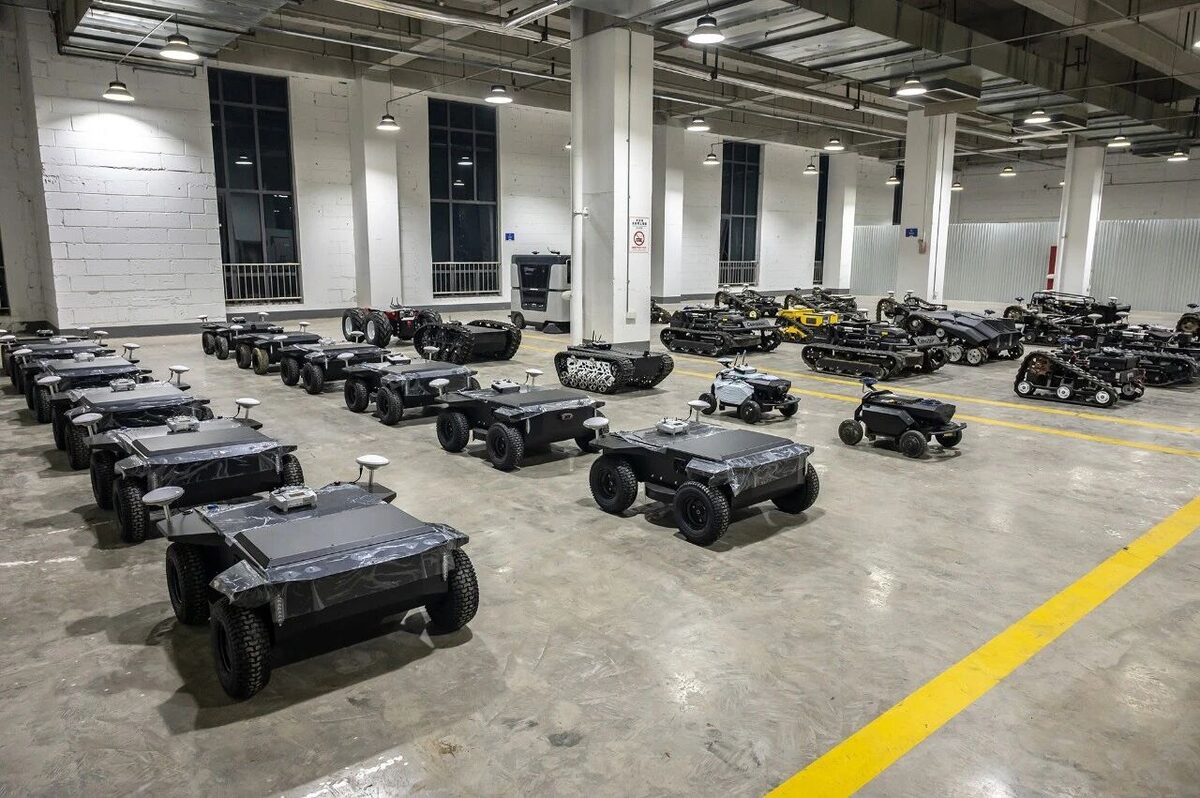
- Mixed farms → both: the tracked machine takes the rough blocks, the electric R1 finishes the level, maintained zones.
The navigation itself is explained in plain terms in our RTK-GNSS and LiDAR article, and the labor-hour math for your wage level is in the cost-vs-manual breakdown.
What changes when the machine arrives
A grass field is cut today and grows back in days; an orchard is cleared this year and needs it again next year. The work is not complicated — it simply repeats, once and once again. Perhaps the most practical thing autonomy changes is not how fast one cut goes, but that part of the work done every day, every month and every season can finally be handed to the machine. The machine takes the repeats; people move to the work that genuinely needs experience, judgment and management. That does not mean replacing everyone. It means stepping people out of labor that only repeats — and leaving their time for what is worth more.
Quick answers
Which platform is right for a large farm?
Flat, maintained, low-noise work suits the electric R1; slopes over roughly 15°, brush and rough new land point to the tracked T1-900A. Mixed farms often run both on one autonomy package.
Does an autonomous mower need a boundary wire?
No. Working areas and no-go zones use electronic-geofence virtual walls set on the controller, so there is no wire to bury or later cut.
How long does the R1 run, and what happens at low battery?
About 2 hours and 4,000 m² per removable LiFePO4 pack; at low charge the machine auto-docks, recharges and resumes, or a spare pack is fitted after power-off.
Does the machine work with no operator present?
On routine blocks it navigates, avoids obstacles and resumes on its own, supervised remotely with alarms; a manual override is kept for moving between blocks or tricky corners.