
Glamping has changed what campgrounds compete on. Tents are bell-shaped and pre-pitched; caravans sit on level hardstands with private fire pits; guests pay for atmosphere, and they judge everything — including the grass. A site with uneven, weedy lawns looks neglected in person and worse on Instagram. Yet the same features that make a campsite attractive are what make its grass hard to cut: tents, poles, ropes, fire rings, picnic tables and narrow gaps between pitches.
This guide looks at why traditional mowing frustrates campground operators, how an autonomous electric mower changes the daily routine, and the limits you should know about before you buy.
Three mowing problems every campground knows
In conversations with campsite and holiday-park operators, the same three complaints come up repeatedly.
1. Noise that drives guests away
Weekends are when mowing often has to happen, and weekends are also when guests are sleeping in after a late night around the fire. A conventional petrol mower is one of the loudest pieces of equipment on a site. Start one near occupied pitches at 8 am and the damage is immediate: complaints at reception, bad reviews, and guests who do not come back. Many operators respond by delaying mowing, which only lets the grass get further ahead.
2. Broken-up terrain that large machines cannot enter
An open field is easy. A campground is the opposite: tent pitches, canopy poles, fire pits, play areas and fenced utility zones are scattered across the grass. A ride-on mower cannot squeeze between rows of bell tents without risking ropes and pegs, so those areas fall to hand-trimming with a walk-behind mower or a line trimmer. The result is missed strips, scalped edges and ground that never looks uniformly cut.
3. Labour that is hard to plan and hard to keep safe
Peak season means fully booked sites and a labour market where casual workers are scarce and expensive. Off-season, keeping dedicated mowing staff on the payroll makes no sense. In summer, mowing around guests in heat and humidity is slow, tiring work — and any time a worker is operating a spinning blade near tents, children and pets, the safety exposure sits with the business.
What the R1 actually is
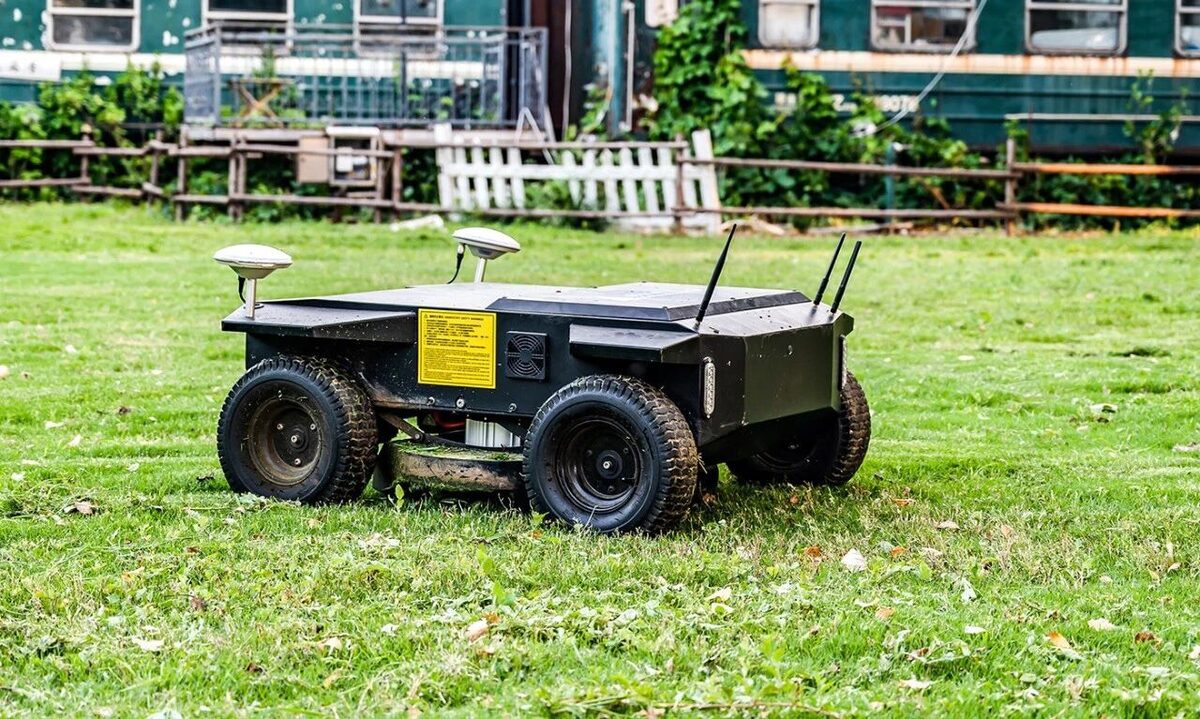
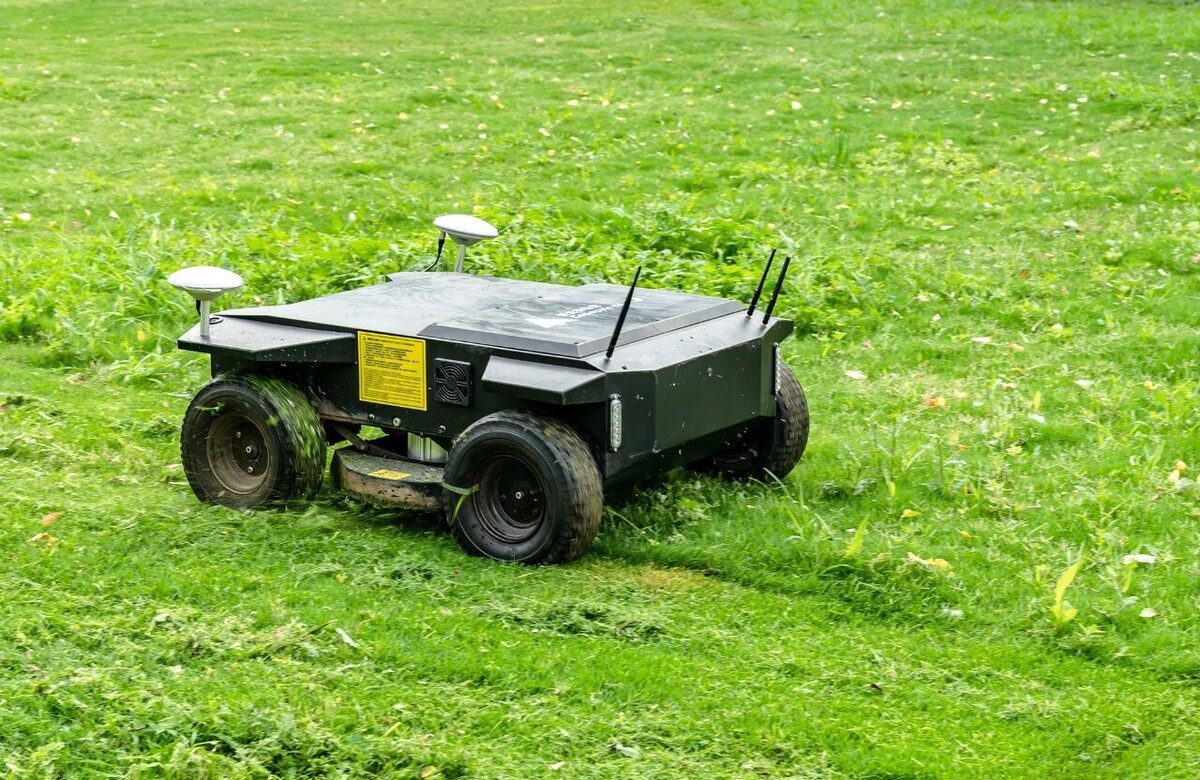
The R1 is a commercial-grade, fully autonomous wheeled mower built around the same navigation system across the WANJI range. It is not a consumer robot scaled up, and it is not driven by an operator: it maps the site, plans the route, mows, avoids obstacles and returns to charge on its own.
The numbers operators care about:
- 790 mm cutting width with dual blades, adjustable cutting height from 20 to 100 mm
- ~2,000 m² per hour of work rate, with one battery pack covering roughly 2 hours / 4,000 m² before the machine returns to charge
- Fully electric — 48V LiFePO4 battery, low operating noise, no exhaust and no fuel storage on site
- Four-wheel drive with differential steering and zero-radius turning
- RTK-GNSS (±2 cm) plus LiDAR for route navigation and obstacle detection, with virtual boundaries and exclusion zones set in the app
Why this fits a premium campsite
Mow while guests are on site
This is the biggest operational change. Because the R1 is electric and quiet, maintenance no longer has to be scheduled around sleep-ins or packed into a noisy weekday window. The machine can run its routes during the day, around occupied pitches, without the sound or fumes of a petrol engine. Guests see the grounds being quietly cared for — an amenity, not a disturbance — and the “we cannot mow because guests are here” compromise disappears.
The marketing line writes itself: the grass is cut quietly, the air stays clean, and nobody smells two-stroke over breakfast.
Green and clean by default
No exhaust means no fumes drifting into tents or dining areas; no petrol engine means no risk of fuel or oil spills on the lawn. For sites that sell themselves on nature, sustainability or low-carbon holidays, an electric maintenance fleet is a genuine part of that claim rather than a brochure contradiction.
Commercial throughput on large open lawns
The 790 mm deck is the gap between consumer machines and commercial equipment. On the open parts of a site — arrival lawns, event fields, recreation areas and the verges along internal roads — the R1 covers ground at roughly 2,000 m² per hour with no operator on board and no fatigue curve. The staff question stops being “who is mowing today?” and becomes “which zones are scheduled this week?”
Tight layouts without a wide turning circle
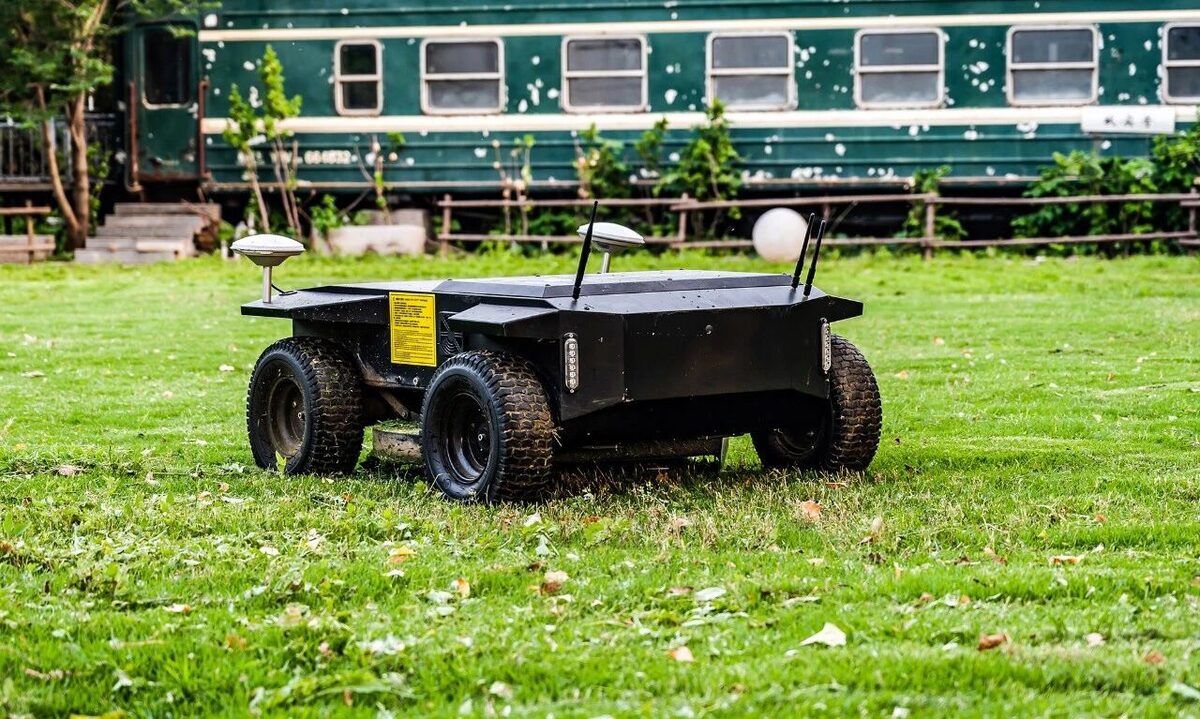
Differential steering lets the machine turn in place, which matters between rows of tents and along narrow service strips where a ride-on would need a three-point turn or simply not fit. Four-wheel drive gives traction across the gentle undulations common on campground ground and slightly soft grass after rain.
Obstacle avoidance around the things a campsite is full of
RTK-GNSS handles the planned route; LiDAR handles what is on it. Trees, posts, equipment, vehicles, guests walking across the lawn and dogs off leads are detected and avoided, rather than hit. Set routes repeat exactly, so finish quality is consistent rather than dependent on which worker operated the mower.
Virtual boundaries, no buried wire
The working area and exclusion zones — fire pits, gravel paths, playgrounds, utility covers, the pond edge — are drawn in the mobile app, with no perimeter cable to install, cut or repair. A seasonal site can move a pitch or add a new amenity and redraw the boundary in minutes. Missions support resume from interruption, and when a pack runs low the machine returns to its charging station automatically.
Questions operators actually ask
Our layout is complex — tents, ropes, fire rings. Can it really work there?
On the open and navigable parts of a pitch layout, yes: the route is planned around fixed features, LiDAR detects anything on the lawn, and zero-radius turning handles tight gaps. Be realistic about two things. Guy ropes and small ground pegs are at the edge of what any sensor reliably detects, so exclusion zones should be drawn over pitched areas rather than relying on the machine to thread between ropes — most operators mow a pitch before it is occupied and keep the machine to roadsides and open lawns during stays. And items left randomly on the grass (towels, chairs, loose equipment) should still be tidied before a scheduled run.
Will it manage wet grass after rain?
Four-wheel drive gives traction on damp, firm ground, and the machine is rated IP54. It is not designed for standing water, saturated soil or flooded ground — running on those conditions risks ruts and turf damage with any wheeled machine. Scheduling the mowing when the surface is reasonably dry is both a ground-care and a finish-quality decision.
How much labour does it actually remove?
The machine removes the operator from the mowing itself; staff instead set zones, check the schedule, keep the lawn clear of loose items and do routine deck maintenance. For a multi-hectare site this changes one person's day from pushing a mower to supervising grounds on a tablet, and it removes the peak-season scramble for casual mowing labour.
How hard is it for seasonal staff to operate?
After the initial site mapping, day-to-day operation is task selection and start/stop in the app — the path planning and charging happen automatically. The mapping and boundary setup are the part worth doing carefully once, ideally with the supplier or dealer, rather than handed to a new seasonal worker.
Where the R1 stops being the right answer
Wheeled machines have honest limits, and pretending otherwise is how buyers end up disappointed. The R1 is the wrong tool for:
- Steep slopes and embankments, including dam walls, riverbanks and roadside cuttings
- Collapsed or subsided ground, deep ruts and potholes
- Mud, soft boggy ground and unsealed rough tracks
For those areas WANJI builds the T1-900A, a tracked hybrid mower with a 900 mm flail deck and rated operation on slopes up to 40°. The wide tracks spread ground pressure and grip surfaces a wheeled machine should not attempt. Campgrounds with steep boundary banks, wooded hillsides or undeveloped rough ground commonly run both machines: the R1 on guest lawns and pitches, the T1-900A on slopes and boundary vegetation. That split — one autonomous system, two purpose-built chassis — is covered in detail in our scene-by-scene selection guide.
| Campground area | Ground | Machine |
|---|---|---|
| Tent & glamping pitches | Level maintained turf, fixed layout | R1 (mow pre-occupation; exclusion zones during stays) |
| Arrival lawns, event & recreation fields | Open, level grass | R1 |
| Internal roadsides and verges | Level to gentle ground | R1 |
| Boundary banks, dam walls, riversides | Steep or slippery slopes | T1-900A |
| Wooded, undeveloped rough ground | Ruts, brush, uneven surface | T1-900A |
The business case in one paragraph
A campground buys an autonomous mower for three reasons that show up on the accounts: it removes workers from the most tedious and injury-prone task on the site, including heat-stress and blade-contact exposure; it replaces recurring casual labour with a fixed asset that runs through peak season without “no staff available” days; and it makes finish quality repeatable — the same cutting height, the same routes, lawns that look like one standard every week. Add the ability to mow quietly while guests are present, and the machine is protecting the product the site actually sells: the experience.