Spraying is the one orchard job nobody looks forward to and nobody can skip. It has to happen on a tight calendar, often in the heat of the day, and it puts a worker on a noisy, moving machine inside a chemical cloud for hours. Miss a window and pest pressure or disease takes the crop; staff it reliably and your best operator is tied up for a week. An autonomous orchard sprayer changes that equation. This guide explains how the WANJI800-60F — an RTK-GNSS-guided, tracked air-blast sprayer — actually works in a plantation, what it does and does not do, and what to check before you buy.
Why autonomous spraying, and why now
Conventional air-blast spraying depends on an experienced driver holding a steady speed and a consistent distance from the canopy, row after row, all day. Coverage quality drifts as the operator tires; chemical is wasted on overlaps and gaps; and labour for this specific job gets harder to find every season. A guided sprayer removes the variation rather than the human: the machine repeats the same planned passes at the same speed and offset every time, while a supervisor oversees the operation and can take over at any moment.
For a dealer, the demand pull is concrete. Orchards, citrus groves and vineyards all face rising wages, tighter chemical-safety rules and a shrinking pool of workers willing to do hot-season spraying. A machine that takes the operator out of the spray plume and reuses one planned route all season pays back in chemical savings, labour reallocation and consistent coverage — the same logic that is already driving adoption of autonomous mowers on the same farms.
What the WANJI800-60F actually is
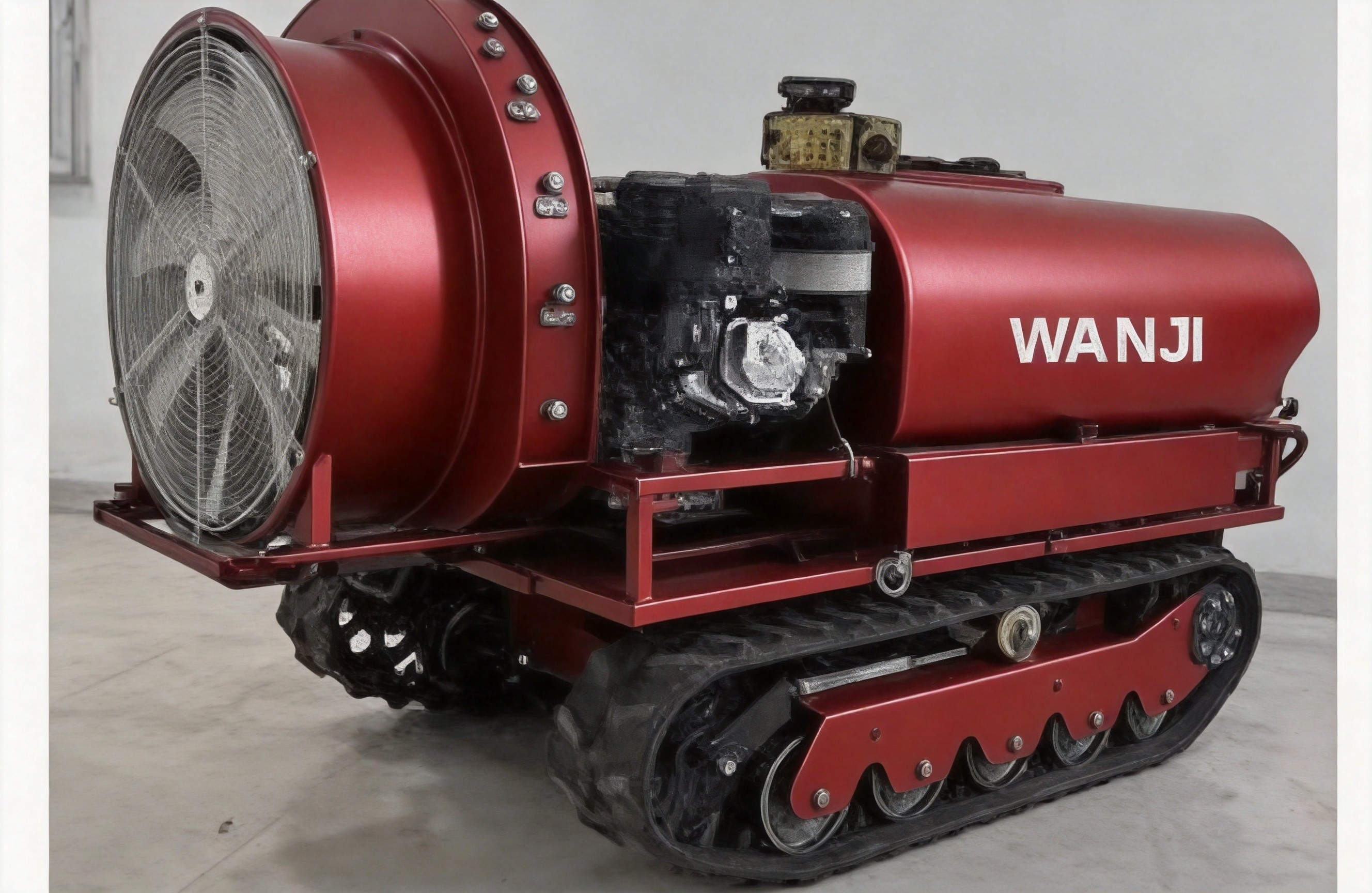
The WANJI800-60F is a crawler-tracked air-blast sprayer with a 400-litre tank and a 5.5 kW gasoline engine driving a Type-52 plunger pump. It runs on the same RTK-GNSS navigation platform used across the WANJI robotic-mower line: you plan the route once in the app, and the machine then drives repeatable passes with no rider on board. A radio remote control stays with the supervisor for setup, tight headlands and full manual control whenever it is wanted.
It is important to be precise about the autonomy. This is supervised autonomy, not an unattended robot. There is no on-board operator during normal passes, but a person plans the route, starts the job, watches the run and is expected to step in with the remote for unusual situations. That is the correct safety model for chemical application today, and it is how the machine is specified.
- 400 L tank (800 jin) with a Type-52 plunger pump at 52–60 L/min — real working capacity between refills
- 60-type, 8-blade fan with 12 dual-direction nozzle groups — air-blast mist driven into the canopy on both sides in a single pass
- Climb capability below 45° on 130 × 18 cm rubber tracks — low ground pressure on hilly, wet and terraced ground
- Travel speed 20–70 m/min, 9-speed drive, operating weight 560 kg, footprint 190 × 100 × 115 cm
- RTK-GNSS app-planned routes + radio remote: electric start and throttle, spray on/off, one-touch stop, pivot turn, 4-direction fan adjustment
How a spraying day works
The workflow is deliberately close to what a crew already does, minus the driving:
- Plan the route in the app. Walk or drive the block once to set the rows, headlands and no-go zones. RTK route guidance then reproduces those passes. Routes are saved, so a block sprayed in spring is called up again — unchanged — for the next application.
- Mix and fill the 400 L tank. The supervisor prepares the chemical exactly as today; the machine changes how it is applied, not the agronomy.
- Start and supervise. The sprayer drives the planned passes itself, air-blasting both sides of the row. The operator monitors from outside the plume and uses the radio remote for gates, tight corners, obstacles or anything unplanned — remote start, throttle, 9 speeds, spray on/off, one-touch stop and pivot turn are all on the controller.
- Adjust the air, not the line. A 4-direction remote fan adjustment lets canopy targeting be tuned for crop stage and row spacing while the pass stays consistent.
- Refill and repeat. Repeatable speed and spacing make chemical use and time-per-block predictable, which makes planning the day — and quoting a spraying service — much easier.
Where it fits: terrain and crop
The tracked, air-blast configuration is aimed at exactly the ground wheeled sprayers handle worst:
- Orchards and fruit trees — repeatable inter-row passes with two-sided canopy coverage
- Citrus groves — dense canopy that needs genuine air-blast penetration, not a mist that sits on the outer leaves
- Vineyards — narrow, regular rows where consistent offset protects fruit and saves chemical
- Hilly and terraced plantations — the 45° climb rating and 130 cm tracks are the headline features here; low ground pressure also helps on wet rows in season
- Nurseries and greenhouse surroundings, plus light on-farm transport between tasks
Two honest limitations. First, as a 560 kg purpose-built orchard machine it is not a high-clearance row-crop sprayer for open field crops. Second, autonomous and RTK features are delivered in market-specific configurations, and chemical-application equipment is regulated differently by country — available navigation functions, accuracy and certification must be confirmed for the destination market before purchase (the spec sheet says so explicitly).
Remote override: why it stays on board
Autonomy and manual control are not opposites here. The radio remote is a core part of the specification, not a fallback afterthought: remote electric start and throttle, 9-speed drive, spray on/off, a one-touch stop, pivot turn and 4-direction fan adjustment. In practice that means a single supervisor can manage the machine safely around people, animals, irrigation hardware and mixed blocks — running autonomous on the long straight rows and taking direct control for the awkward bits. A machine that could only run hands-off would be less useful on a real, messy farm, not more.
The case for a dealer’s fleet line
The WANJI800-60F sits naturally alongside the WANJI autonomous mower range: the same RTK platform, the same app logic, the same kind of customer (orchards, municipalities, large estates, contractors) and the same core story — take labour out of repetitive outdoor passes and make the result more consistent. A dealer who already sells autonomous mowers into a region can open a second, higher-value conversation with the same buyers at a different point in their calendar: mowing is the baseline job, spraying is the regulated, time-critical one. Full export terms, market-specific configuration and the written specification are confirmed per order.
Six checks before you specify an autonomous sprayer
- Row geometry. Confirm row width, headland space and the machine’s 190 × 100 cm footprint and pivot-turn behaviour against your blocks.
- Slopes and ground. Walk the wettest, steepest rows; “below 45°” capability on tracks is strong, but traction still depends on surface and load.
- Canopy and nozzles. Match the 12 dual-direction nozzle groups and fan output to crop height and density; check whether your standard chemicals and rates suit the pump range (52–60 L/min).
- RTK conditions. Steep terraced rows and tall hedgerows can affect satellite reception — ask how accuracy and reconnect behaviour are specified for your terrain.
- Local regulation and certification. Spraying equipment and autonomous operation both carry market-specific rules; confirm documentation before ordering, not on arrival.
- Service and parts. Confirm the warranty terms in writing, the spare-parts arrangement and who locally can support the engine and pump. Every WANJI machine ships with a spare-parts kit and remote engineering support.
Quick answers
Does it spray fully on its own with nobody present?
No. It runs planned RTK-GNSS passes without an on-board rider, but it is designed for supervised autonomy: a person starts and monitors the job and holds a radio remote for setup, obstacles and full manual override at any time.
How much chemical does the tank hold?
The tank is 400 litres (800 jin), fed by a Type-52 plunger pump at 52–60 L/min, with a 60-type 8-blade fan and 12 dual-direction nozzle groups delivering two-sided air-blast coverage.
Can it work on steep or wet hillside orchards?
It is rated to climb below 45° on 130 × 18 cm rubber tracks, whose low ground pressure suits hilly, wet and terraced plantation ground. Real traction still depends on the surface and a full tank, so check your worst rows.
Does it use the same navigation system as WANJI mowers?
Yes — it runs on the same RTK-GNSS platform, with app-planned, repeatable routes. Available navigation functions and accuracy are market-specific and are confirmed per destination.
What does it cost, and how do I order?
Pricing and export terms are quoted per configuration, quantity and destination market. See the Buyer FAQ, download the WANJI800-60F specification sheet (PDF), then request a quote with your country, crop and hectare count.