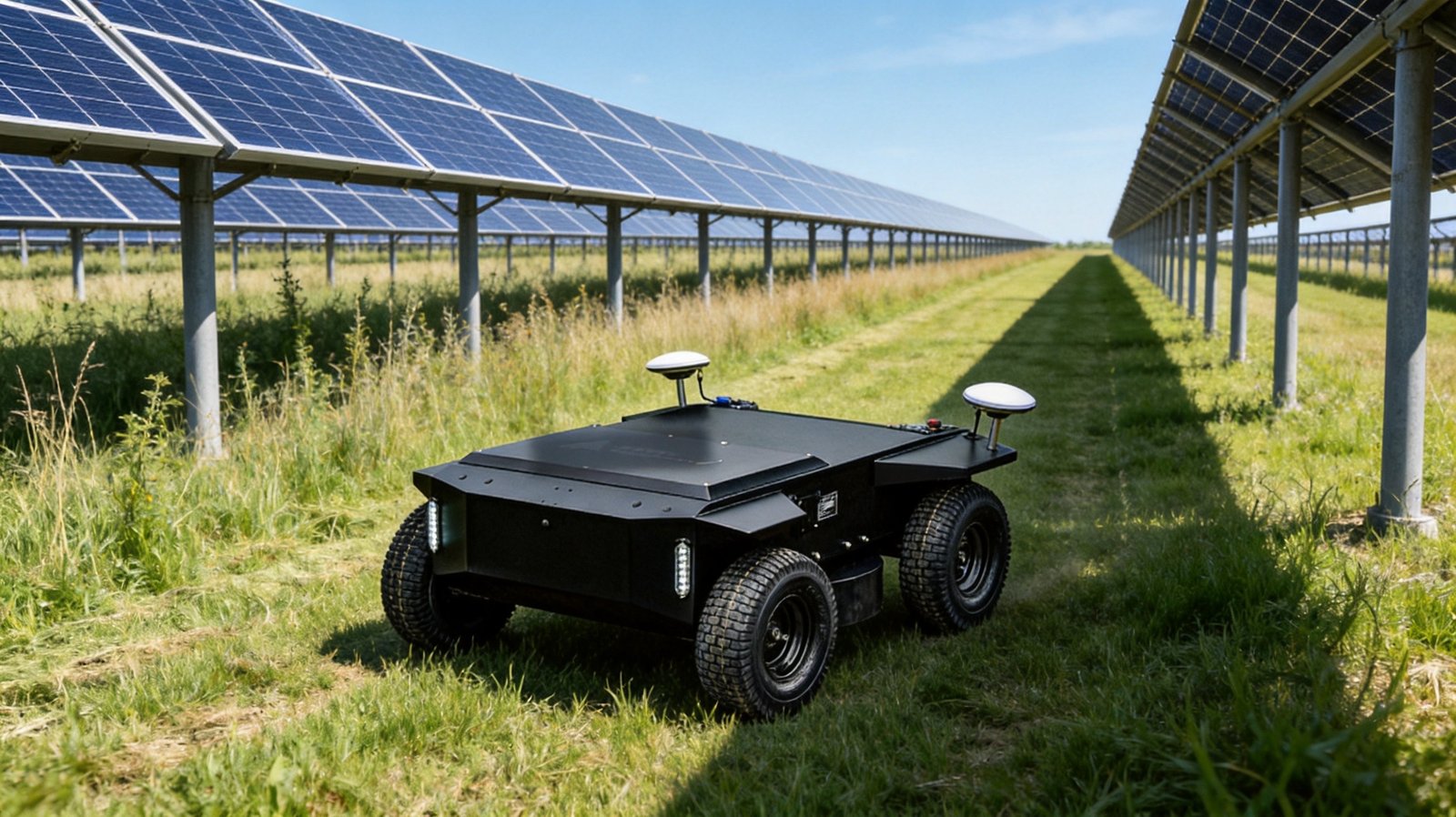
The short answer: a solar farm is one of the easiest places to put autonomous mowing to work — the boundary is fixed, the array layout is regular, and the same routes repeat all season. The wheeled WJ-R1 was built for exactly that kind of site: it turns on the spot between rows, runs full electric with no fuel handling, follows RTK-GNSS routes without boundary wire, and returns to its own charging dock. On flat, well-laid-out blocks, that changes mowing from a crew task into a supervised routine.
1. Solar rows are not an open lawn
From the air a PV plant looks like empty grass with panels on it. At ground level the machine works in a corridor: rows of modules overhead, support posts on both sides, cable trays and conduits along the ground, inverters and combiner boxes at the row ends. Getting in is only the first question — the mower also has to turn, come back out, and keep a safe distance from everything that should never be hit.
That is why the choice is not only about cutting capacity. Machine footprint and manoeuvrability matter as much as the deck. A mower that needs a three-point turn at every row end wastes the space you do not have, and every wide turn is another chance to clip a post or a tray.
2. A chassis that turns on the spot
The WJ-R1 uses four-wheel differential steering with in-situ zero-turn: it rotates on the spot instead of describing an arc. At the end of a row it simply turns and starts the next pass — no reversing manoeuvre, no extra headland to keep clear, no torn turf from a ride-on turning circle.
- 790 mm twin-blade deck — two 850 W blades at 3,000 rpm, cutting height 20–100 mm from the lifting deck
- 118 kg net weight and a compact wheeled layout, sized for corridors rather than open fields
- 0–6 km/h travel speed, with peak efficiency around 2,000 m²/h
Where the corridor is regular and the ground is firm, this is the machine we would put into the rows first. For the wider selection question — deck width against your narrowest clear corridor — see the solar farm mower selection guide.
3. Full electric means fewer daily maintenance items
A petrol mower on a solar site brings a fuel can, oil changes and exhaust into a place full of electrical equipment. The R1 removes that whole category: a 48V LiFePO4 removable pack, no fuel handling, no engine oil, no idle noise. For sites near housing, offices or hospitals — and for O&M teams who simply want fewer service items — low noise and zero exhaust are operational benefits, not marketing ones.
The working numbers: about 2 hours per charge (up to 2.5 hours on light turf), roughly 4,000 m² per pack, and a 20A fast charger that brings a pack back to full in about 2 hours. Packs are exchanged cold — power off, release the rear locking pin — so plan charging through the dock schedule rather than mid-shift swaps.
4. Fixed site, clear routes: let it run itself
This is where a solar farm suits autonomy better than almost any other grassed site. The boundary never moves, the rows never move, and the work repeats on a weekly rhythm. Once the site is mapped and the zones are drawn, the R1 works its RTK-GNSS routes with self-developed path planning and multi-zone scheduling — no boundary wire to bury along hundreds of metres of cable corridor.
- LiDAR fusion for dynamic obstacles — the machine stops and reroutes around people, animals and debris, with alarms on the remote and the app.
- Auto-charging dock included — the R1 returns on its own, recharges, and resumes the remaining schedule without an operator on site.
- Remote controller + mobile app — supervision and alarms without walking the rows.
One honest caveat: under the panels themselves, GNSS reception on any brand can drop from Fix to Float. The R1 combines GNSS with IMU and LiDAR to hold its row through short shading events, but row orientation and shading still deserve a look before purchase — the details are in our GNSS signal article.
5. What actually changes for O&M
Solar vegetation work has moved through three stages: hand crews with trimmers, then ride-on machines with drivers, and now scheduled autonomous routes. The third stage does not remove people — it moves them. Instead of driving every pass, the team checks the route map, handles alarms, and finishes the close-in strip around posts, trays and panel edges that no autonomous machine should be trusted with.
Daily coverage becomes a scheduling question rather than a labor question: about 4,000 m² per pack, with the dock handling the recharge-and-resume cycle. To size a block properly, run the numbers at 65% field efficiency using the formula in the selection guide, and compare against your current crew hours with the manual mowing cost breakdown.
6. Where the R1 is not the right machine
The R1 is a flat-block specialist. Embankments, drainage swales and rough banks belong to the tracked platforms — the WJ-T-900A (up to 40°) or the WJ-T-1100M / T-1300M (up to 60°) — and blocks that have grown into tall grass and light brush are flail work for the WJ-F-1000L (45° working slope). Many real sites end up mixed: tracked machines on the rough perimeter, the R1 quietly doing the regular panel blocks. The solar vegetation management page shows how the range fits together.
Quick answers
Which blocks suit the WJ-R1?
Flat, regular blocks with consistent corridors, especially where noise and emissions matter. Slopes and brush go to the tracked T-series or the F-1000L flail.
How much can it mow per day?
About 4,000 m² per pack at roughly 2 hours per charge; the auto-dock recharges and resumes, so daily coverage depends on how many cycles you schedule.
Does autonomy mean nobody visits?
No. The machine does the repetitive rows; people handle alarms, inspections and the close-in strip around posts and cables.